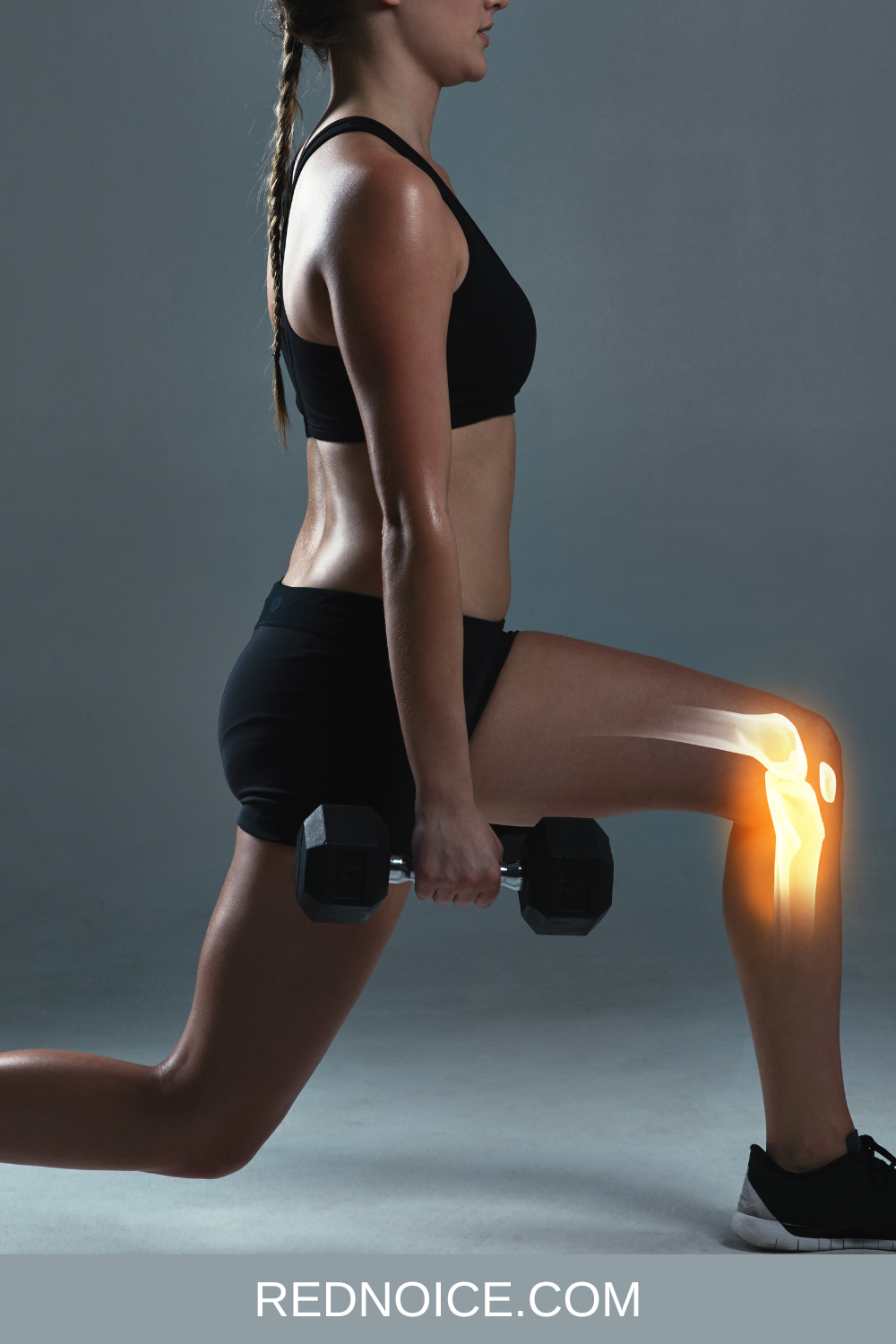

If you’re dealing with knee discomfort, weak knees, or chronic knee problems, you’re certainly not alone. Knee issues are among the most common complaints health professionals address daily.
The encouraging news is that targeted exercise can be a powerful tool to reduce strain and build resilience in your joints—and you can achieve this without any special equipment.
Strengthen Weak Knees at Home: The Complete Guide
The key to long-term knee stability is consistently strengthening the surrounding muscles: your quadriceps, hamstrings, and glutes. These low-impact movements minimize joint stress while maximizing strength gains (1).
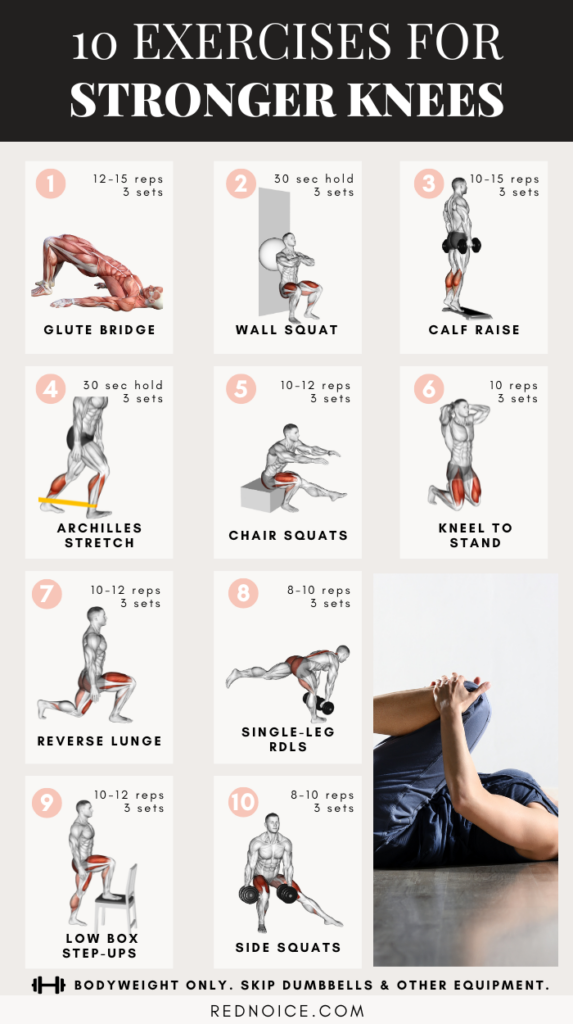
Below are 10 effective, physical therapy-approved exercises that can be performed at home today, requiring zero equipment (2).
10 Best Knee Strengthening Exercises for Stronger Knees
Foundational Strength: Non-Weight-Bearing & Isolation
These exercises focus on isolating critical support muscles and improving mobility without placing full body weight through the knee joint. They are excellent starting points for sensitive knees.
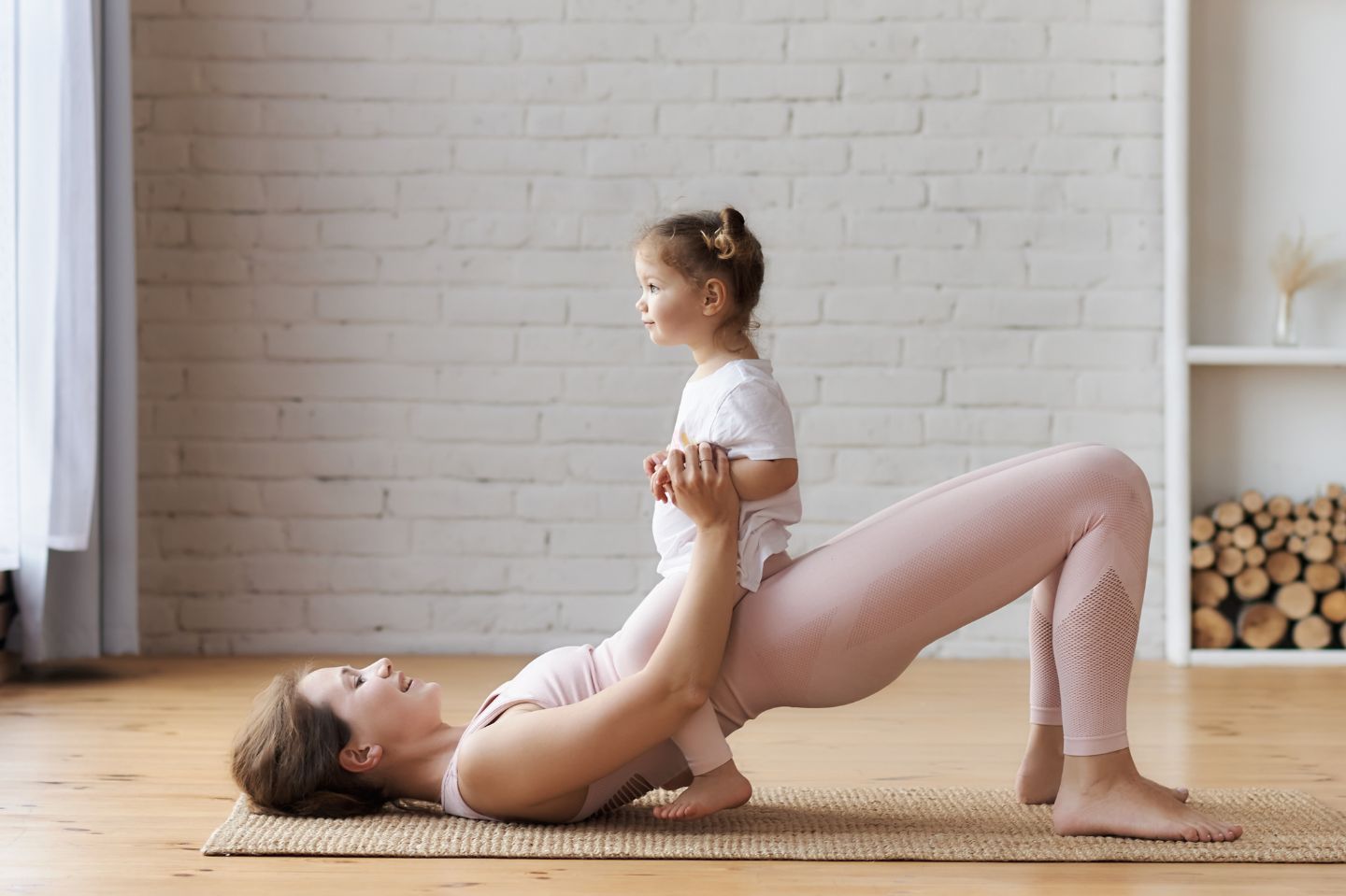
1. Glute Bridges – Essential Hip and Knee Stability
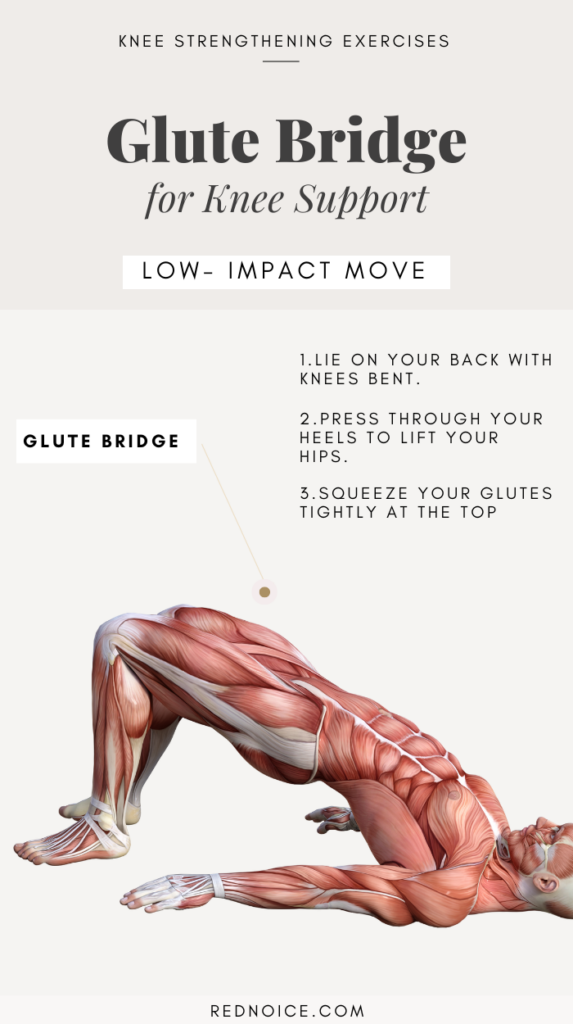
Your glutes and hamstrings are critical for stable knees. This posterior chain exercise strengthens your entire backside and provides robust joint support.
How to Perform Glute Bridges:
- Lie on your back with knees bent and feet flat.
- Lift your hips until your body forms a line from your shoulders to your knees.
- Squeeze your glutes at the top, and avoid arching your back.
- Lower hips slowly and deliberately back to the starting position.
Reps: 12-15 per set, 3 sets
Perfect for: Building foundational support and minimizing strain
2. Wall Squat / Wall Sit – Build Quad Endurance Safely
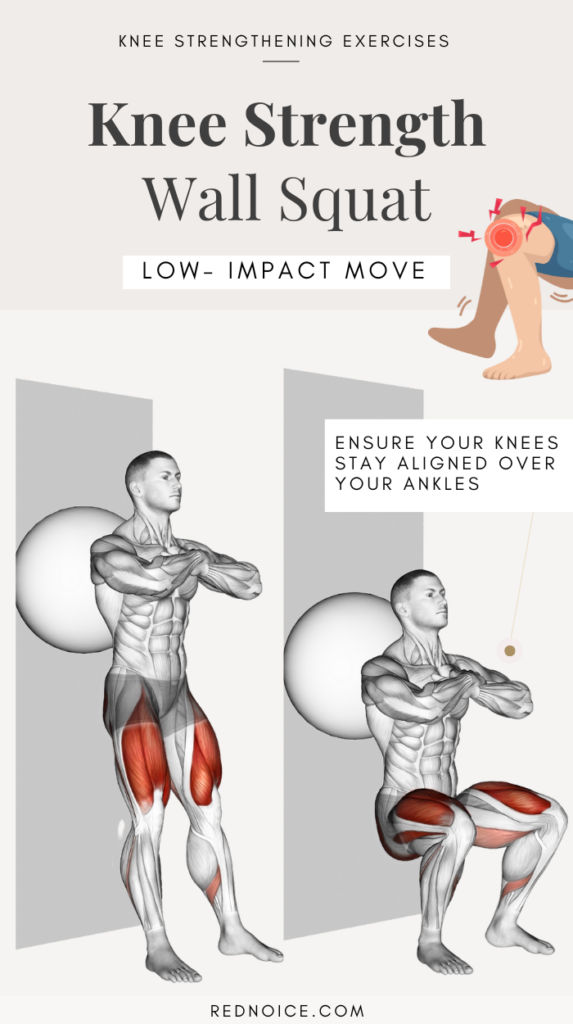
This isometric (static hold) exercise helps strengthen and build endurance in your quadriceps, supporting the knee by increasing muscle stamina and joint stability. Since it involves no joint movement, it is ideal for sensitive or painful knees.
How to Perform Wall Squats:
- Stand with your back to a wall and your feet shoulder-width apart.
- Slide down the wall until hips and knees are bent for comfort.
- Keep your entire back against the wall and ensure your knees stay aligned over your ankles.
- Hold for 30-60 seconds, or as long as you can maintain good form without pain.
Reps: 3 holds per session, rest 1 minute between holds.
Perfect for: Building static, no-impact knee strength
3. Calf Raises – Lower Leg Stability
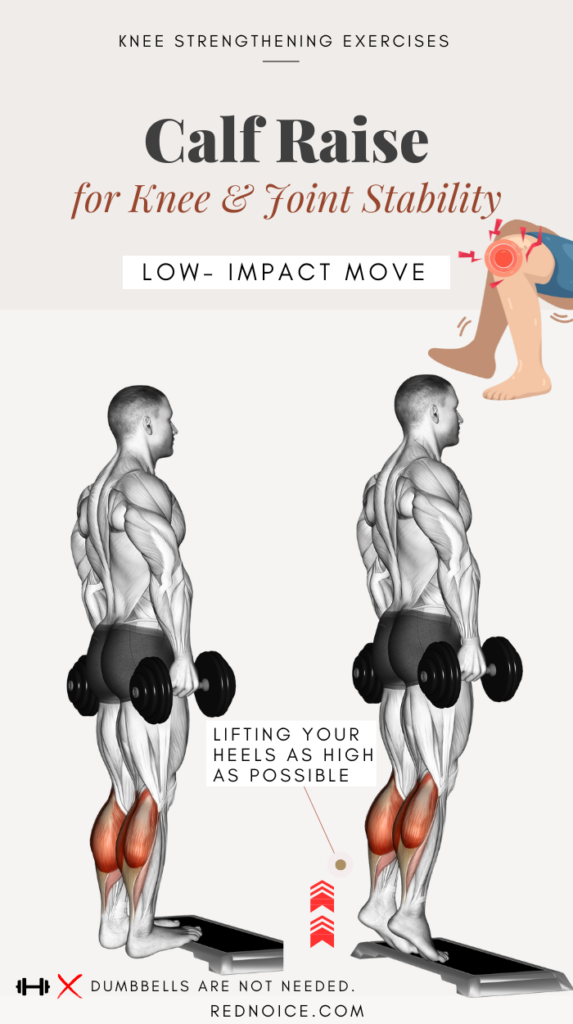
The calf muscle contributes directly to shock absorption and knee joint stability during walking.
How to Perform Calf Raises:
- Stand tall, holding onto a chair or wall for balance if needed.
- Slowly rise up onto the balls of your feet, lifting your heels as high as possible.
- Pause briefly at the top.
- Slowly and with control, lower your heels back down to the floor.
Reps: 10-15 per set, 3 sets
Perfect for: Improving lower leg and ankle stability
4. Standing Back Achilles Stretch (Optional Resistance)
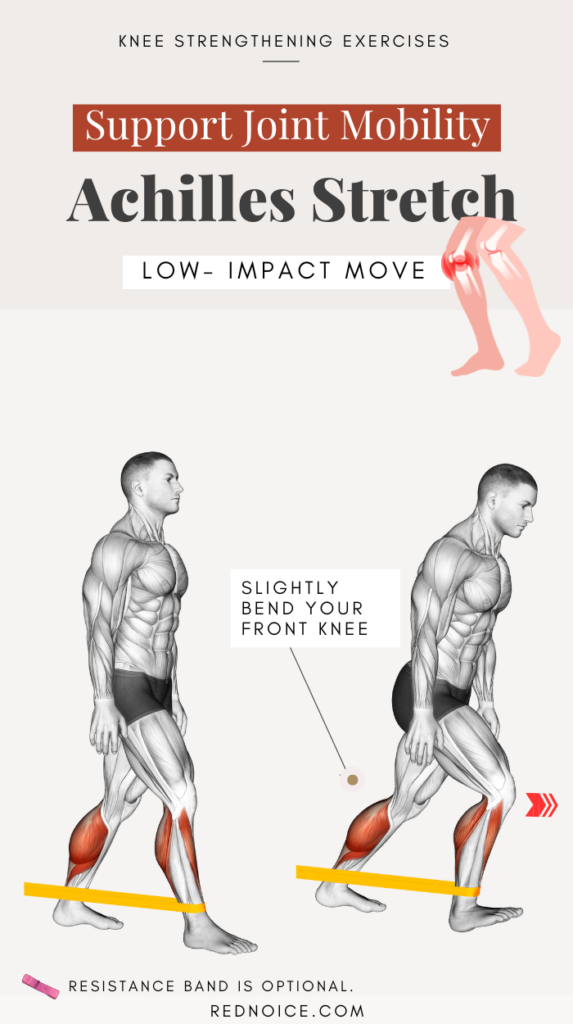
This gentle stretch increases ankle and calf flexibility. Improved flexibility in these areas can help maintain proper knee alignment and ease strain during daily activities. Using a resistance band is optional and can deepen the stretch.
How to Perform the Stretch:
- Stand upright, facing a wall or stable object for balance.
- Step one foot back, heel flat, and toes forward.
- Bend the front knee and lean forward to stretch the calf.
- Use a band around the foot for a deeper stretch (optional).
- Hold the stretch for 30 seconds.
Reps: 3 holds per side
Perfect for: Improving flexibility, which supports overall joint health
Controlled Loading & Functional Strength
These exercises safely introduce controlled body weight to strengthen your knees for functional, real-world activities like standing, walking, and climbing.
5. Chair Squats – Safe Squat Variation for Bad Knees
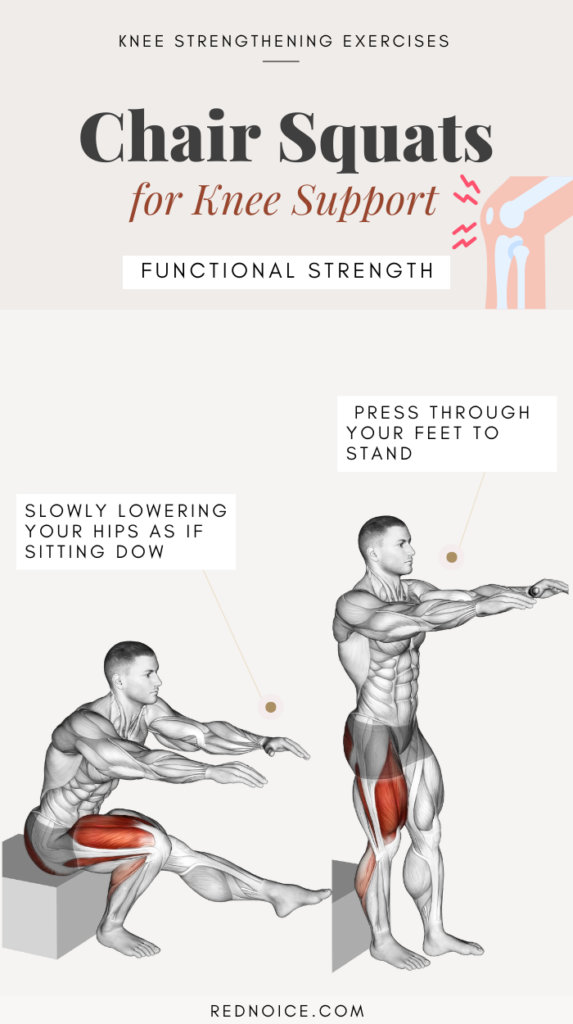
This modification uses a chair to guide your squat, making it easier to maintain safe form and depth. Chair squats strengthen the quadriceps and glutes, which are crucial for supporting the knee and reducing the risk of strain.
How to Perform Chair Squats:
- Stand in front of a sturdy chair, feet hip-width apart.
- Lower hips as if to sit, keeping chest up and core engaged.
- Tap the chair lightly with the glutes, then stand and squeeze the glutes.
- Ensure your knees track in line with your toes.
Reps: 10-12 per set, 3 sets
Perfect for: Learning proper form safely with a controlled load
6. Kneel to Stand – Daily Function Builder
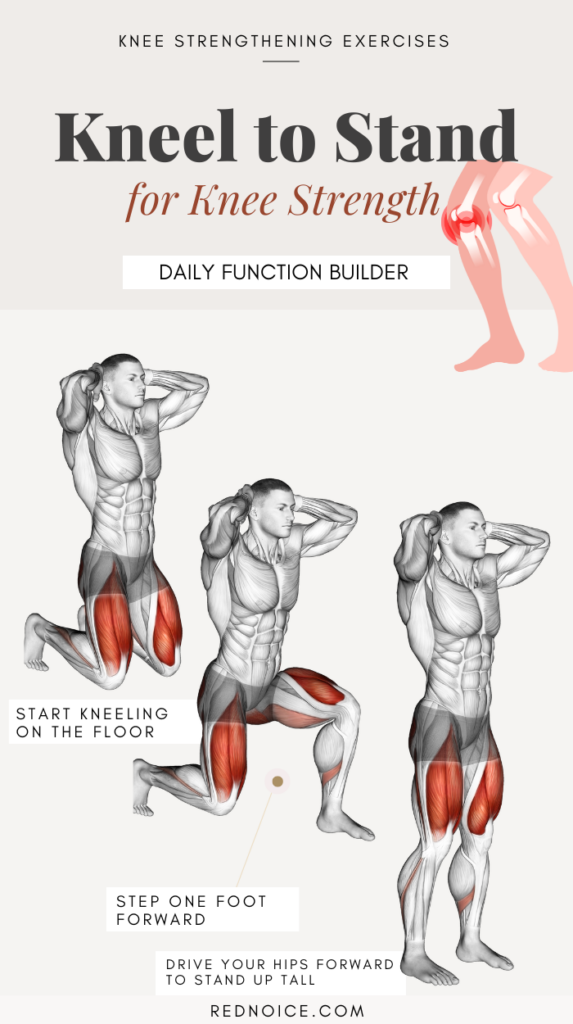
This movement directly mimics the functional strength required to get up off the floor or to stand up from low surfaces.
How to Perform Kneel to Stand:
- Start kneeling on the floor (use a folded towel or mat for padding)
- Step one foot forward, placing it flat on the floor in a half-kneeling position
- Push through your front foot and drive your hips forward to stand up tall.
- Return to kneeling and switch leading foot each time.
Reps: 10 per side (i.e., 20 total reps) per set, 3 sets
Perfect for: Strengthening the ability to transition from low to high positions
7. Reverse Lunges – Low-Stress Lunge
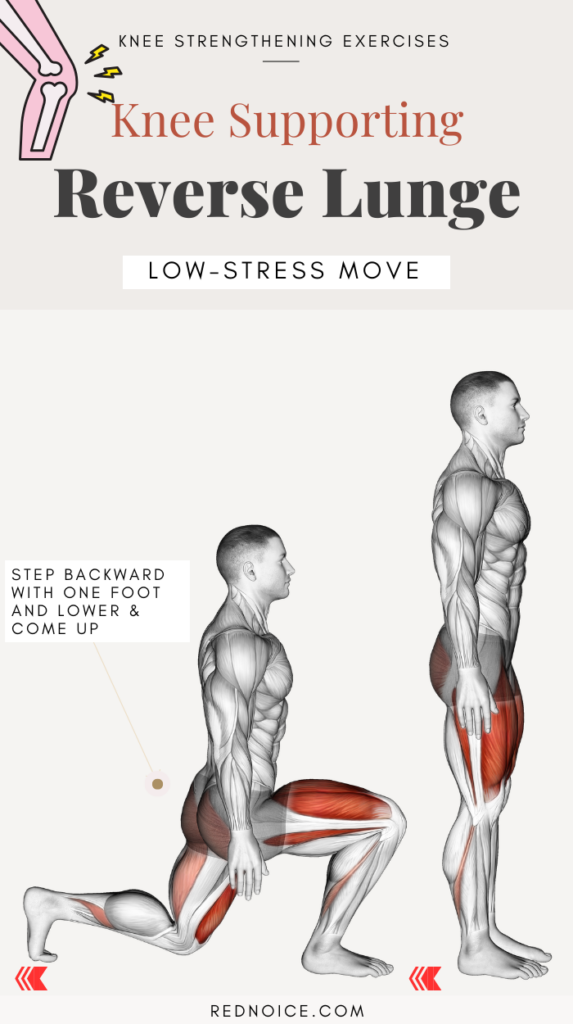
Stepping backward in a reverse lunge reduces pressure on the knee joint compared to a forward lunge, making it a safer option for building leg strength while minimizing knee discomfort and strain.
How to Perform Reverse Lunges:
- Start standing tall
- Step one foot back and lower until the knee bends to 90 degrees.
- Your back knee should hover just above the floor.
- Ensure your front knee stays stacked directly over your front ankle.
- Push off your front heel to return smoothly to the start position.
Reps: 10-12 per side, 3 sets
Perfect for: Building powerful legs with reduced strain on the knee joint
8. Single-Leg RDLs (Bodyweight Only) – Balance and Hamstring Strength
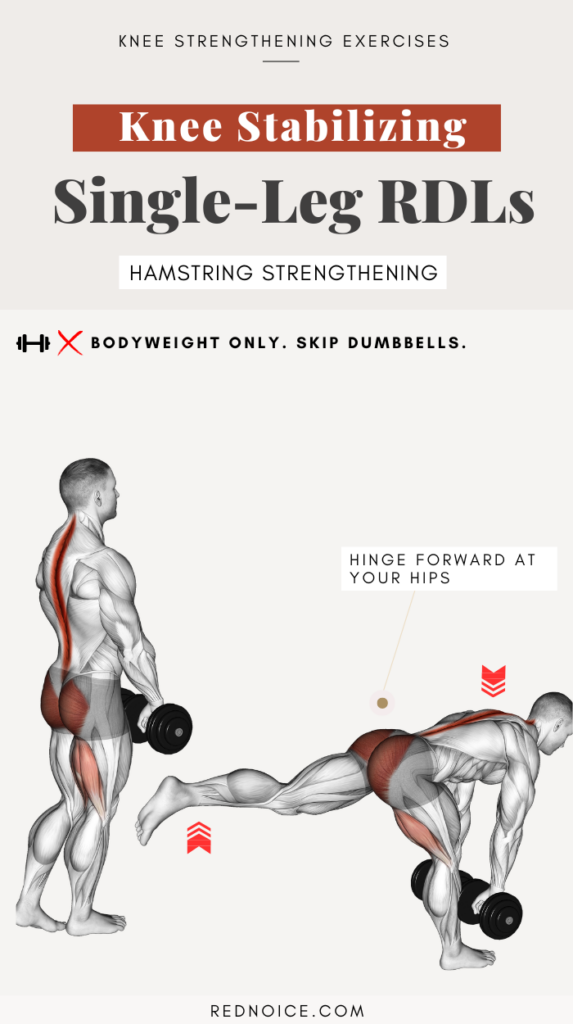
This movement strengthens the hamstrings and glutes of the standing leg, improves balance, enhances knee stability, and helps protect against falls during walking and daily movement.
How to Perform Single-Leg RDLs:
- Stand on one leg, knee slightly bent; use support if needed.
- Hinge at the hips, extend the free leg back for balance.
- Maintain a flat back and keep your hips level.
- Lower until a hamstring stretch is felt, then return using the glute and hamstring.
Reps: 8-10 per side, 3 sets
Perfect for: Improving single-leg stability and posterior chain strength
9. Single-Leg Step-Ups (Low Box) – Functional Knee Exercise
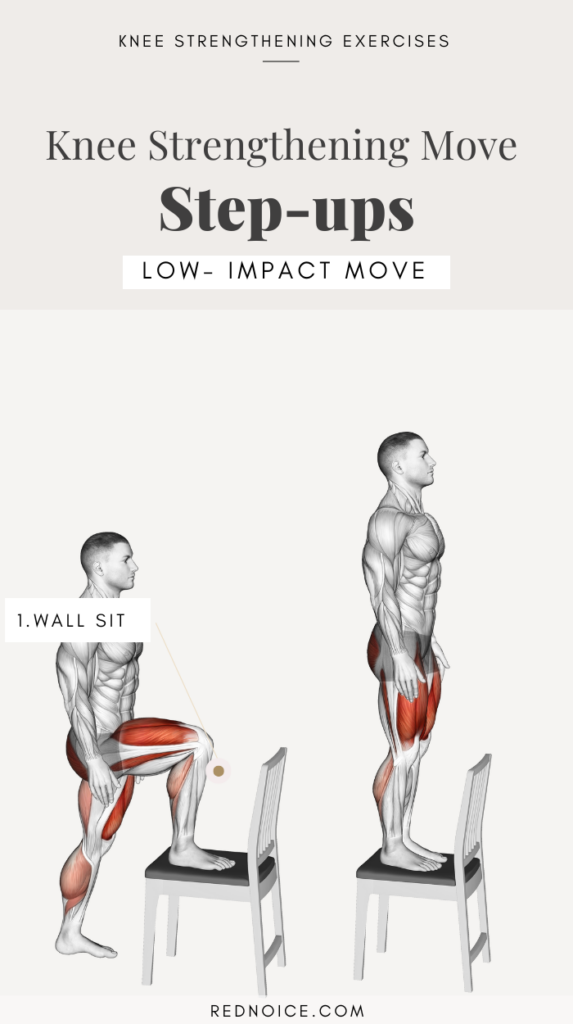
This exercise is a fundamental knee-strengthening movement because it mimics stair climbing. Start with a very low, stable step (4-6 inches) and prioritize control over height.
How to Perform Step-Ups:
- Place your entire right foot firmly on a low step.
- Lean forward, press through your heel to stand tall.
- Keep your left foot floating—focus on using only the standing leg’s muscle strength.
- Slowly lower back down with control.
Reps: 10-12 per side, 3 sets
Perfect for: Building real-world knee strength needed for daily life
10. Side Squats – Unilateral Leg Power
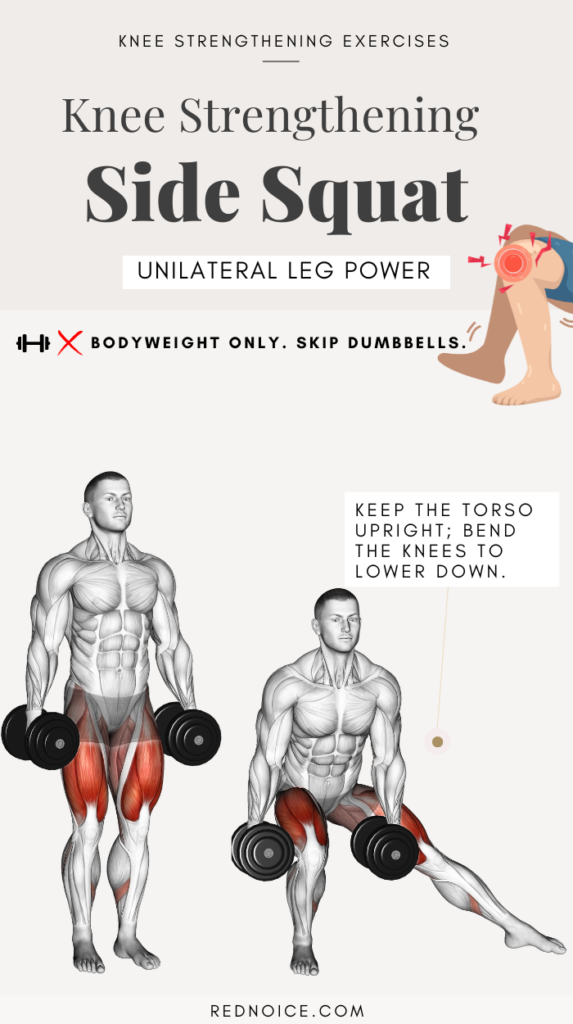
The stationary split squat lets you focus on one leg at a time, enhancing strength and control in the quads, hamstrings, and glutes while reducing the risk to the knee. Using support improves safety for sensitive knees.
How to Perform Split Squats:
- Get into a lunge stance (one foot forward, one foot back)
- Keep the torso upright; bend the knees to lower down.
- Push through your front heel to stand back up.
- Hold as support to avoid wobbling for safety.
Reps: 10-12 per side, 3 sets
Perfect for: Advanced leg power training with stability support
Your Complete Knee Strengthening Workout Plan at Home
For best results:
- Perform this knee strengthening routine 3 times per week.
- Start with the Foundational exercises and master form before moving into the Controlled Loading movements.
- Stop immediately if you feel sharp or increasing pain. Discomfort is normal; pain is a signal to stop.
Final Thoughts: Stronger Knees Are Within Reach

Managing knee discomfort and improving function is absolutely achievable through consistent, targeted, low-impact strength training at home. By focusing on the muscles that stabilize your knee joint, you can improve comfort and build long-term resilience.
Remember: Always consult your healthcare provider or physical therapist to tailor an exercise plan to your specific needs before starting any new routine.
IMPORTANT DISCLAIMER
This article provides general information and is not a substitute for professional medical advice, diagnosis, or treatment. Always seek the advice of your physician, physical therapist, or other qualified health provider with any questions you may have regarding a medical condition or before starting any new exercise program.
Ready to strengthen your knees? Save this pin and start your journey to pain-free movement today!