Winter breakfast tables deserve something warm, cheesy, and built for sharing.
A casserole that comes out of the oven golden and bubbling, fills the house with the smell of sausage and melted cheddar, and has everyone at the table reaching for a second slice before they finish the first.
That is this hash brown cheesy potato casserole.
It is cozy in the way only a cheesy potato bake can be.
It feeds a crowd without any extra effort — one 9×13 dish serves twelve generous portions. And it is genuinely holiday-ready, which means it belongs on your Christmas breakfast table, your Easter brunch, your Thanksgiving morning, and any weekend when the whole family is home, and nobody wants to stand at the stove.
It is also a casserole you can make ahead. Assemble it the night before, refrigerate it, and slide it into the oven while the coffee brews.
Or freeze it for up to three months and pull it out the morning you need it. That is what makes this a holiday dish worth keeping in the rotation — not something you make once a year, but something you handle before the morning starts.
And here’s what makes this version different from the one you grew up with.
If you love a cheesy hash brown casserole but do not love the heavy, weighed-down feeling that follows a plate of sour cream and cream of chicken soup, this version solves that.
The sour cream is mostly replaced with blended cottage cheese and Greek yogurt, which keeps all the creamy tang while adding real protein instead of just fat. The base includes browned breakfast sausage and eggs.
Sharp cheddar and a buttery cornflake topping finish it off.
What comes out of the oven is a casserole with 24 grams of protein per serving — roughly two and a half times what the traditional version delivers — and it doesn’t taste lightened up.
It tastes like the casserole you want on a cold winter morning. It just happens to carry you through the afternoon.
Why This Recipe Works
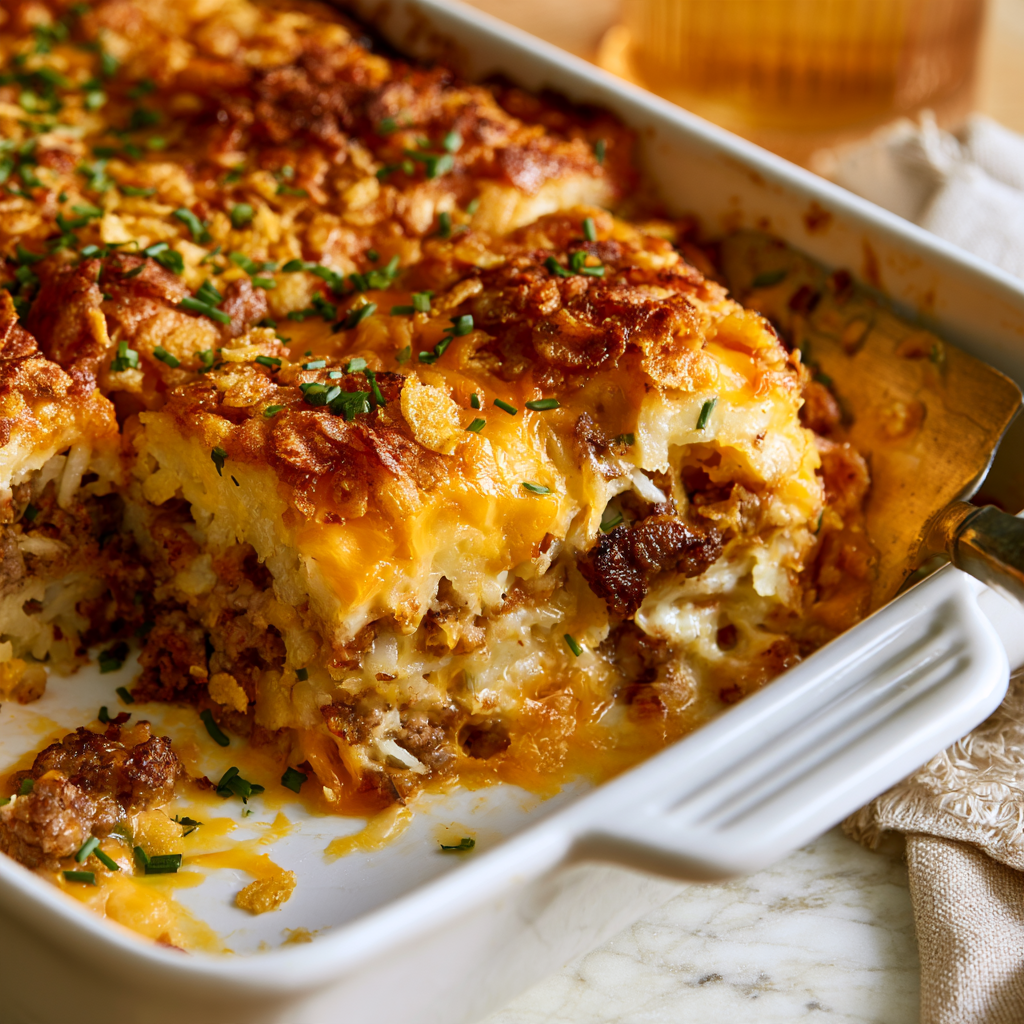
- Blended cottage cheese and Greek yogurt replace most of the sour cream. They bring the same tang and creaminess, and they deliver about 46 grams of protein between them. Blending the cottage cheese smooth helps it disappear into the base instead of leaving curds in the bake.
- Eggs turn a side dish into a full breakfast. Eight eggs add 48 grams of protein to the whole casserole and give the base enough structure to hold together when you cut it. Without them, the casserole turns to loose potatoes in cream.
- Browned breakfast sausage adds flavor and protein in one step. It seasons the whole casserole, and the rendered fat is what gives the potatoes something to cook in. Drain it properly so the casserole does not turn greasy.
- Squeezing the thawed hash browns dry is the single biggest reliability fix. Frozen hash browns carry a lot of surface water. Left in, that water turns the casserole soupy and the topping soggy. A clean kitchen towel and a firm squeeze remove it.
- The cornflake topping makes this a hash brown casserole, not a strata. Crushed cornflakes tossed with melted butter and baked on top is the classic Cracker Barrel finish. It browns and crackles, giving the casserole its signature texture.
- Bake the casserole covered first, then uncovered. The lid traps steam so the center cooks through evenly. The uncovered finish dries the top and sets the cornflake crust.
- Resting 10 minutes before serving is what gives you clean slices. The eggs continue to set as the casserole cools. Cut it while it is bubbling, and it slides apart on the plate.
- You can make it ahead or freeze it. Assemble the night before and refrigerate, or freeze fully baked and reheat from frozen. Both work, and both keep the topping crisp if you handle them right.
- The dish works as breakfast or as a side. Served as breakfast, it delivers 24 grams of protein per serving. Served as a side dish alongside a holiday meal, it feeds twelve and works as a cheesy potato casserole without any expectation of being the main protein.
- The protein math is honest. Sausage, eggs, cottage cheese, Greek yogurt, and cheddar deliver about twenty-four grams per serving across twelve portions.
High Protein Hash Brown Cheesy Potato Casserole
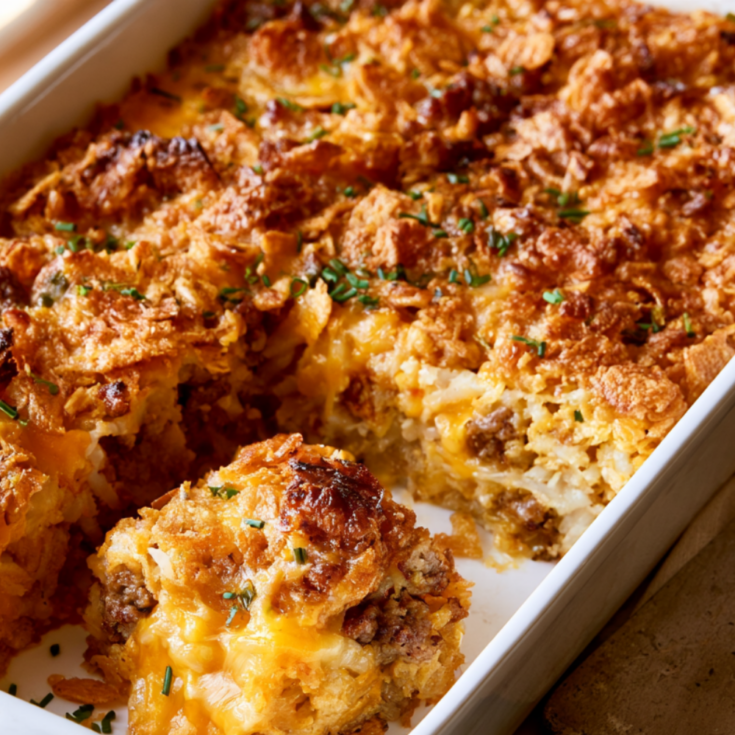
A creamy, cheesy hash brown casserole with browned breakfast sausage, eggs, blended cottage cheese, and Greek yogurt under a buttery cornflake topping. Make-ahead and freezer-friendly.
Ingredients
For the Base
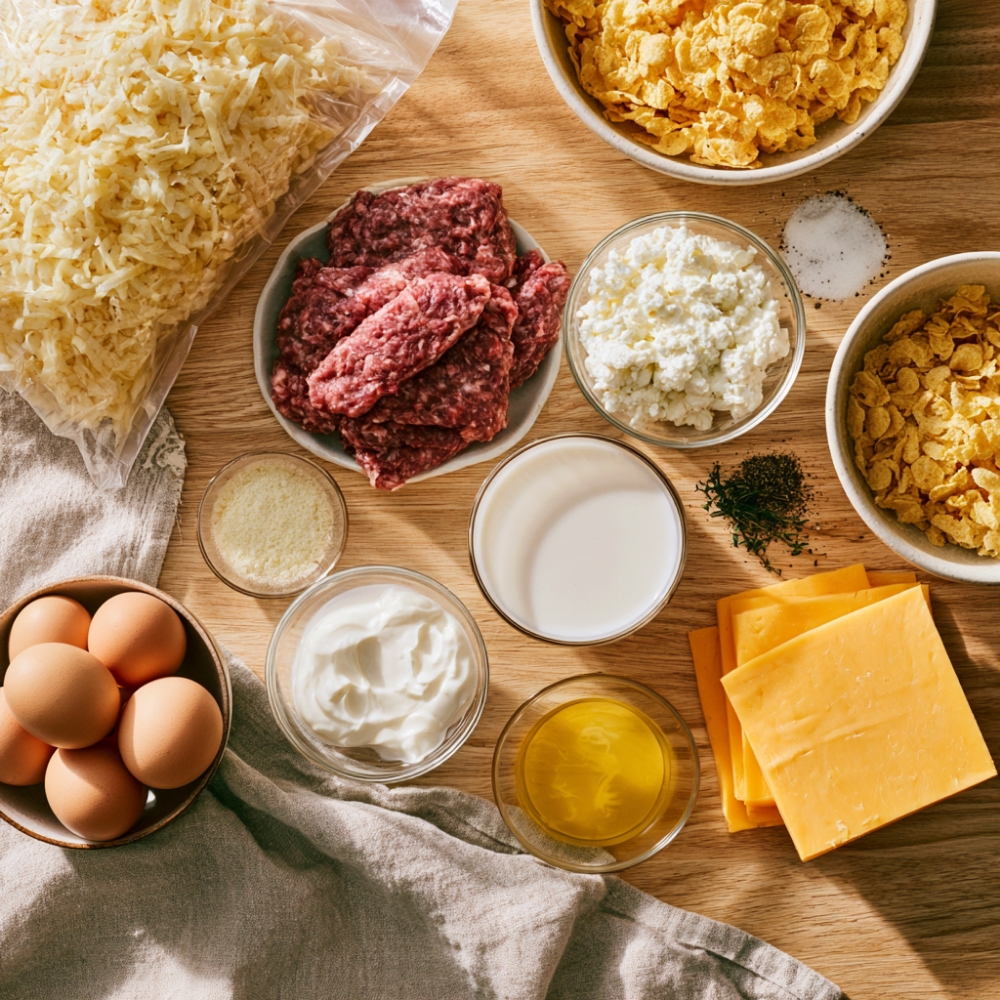
- 1½ lbs breakfast sausage, mild or hot, casings removed
- 30 oz frozen shredded hash browns (about 1 bag), thawed and squeezed dry
- 8 large eggs
- 1 cup 2% cottage cheese, blended until smooth
- 1 cup plain Greek yogurt
- 1 cup whole milk
- ½ cup unsalted butter, melted
- 1 tsp garlic powder
- 1 tsp onion powder
- 1 tsp dried thyme
- 1 tsp kosher salt
- ½ tsp black pepper
- 2 cups sharp cheddar, freshly shredded, divided
For the Cornflake Topping
- 3 cups cornflakes, lightly crushed
- ⅓ cup unsalted butter, melted
- ¼ tsp kosher salt
For Serving
- Sliced scallions
- Hot sauce
- Sour cream or extra Greek yogurt
Instructions
- Thaw and squeeze the hash browns. If your hash browns are frozen, thaw them in the refrigerator overnight or spread them on a sheet pan for 30 minutes at room temperature. Once thawed, wrap them in a clean kitchen towel and squeeze firmly over the sink to remove as much water as possible. This step keeps the casserole from turning soupy.
- Preheat and prep. Preheat the oven to 375°F. Grease a 9x13 baking dish with butter or nonstick spray.
- Brown the sausage. Heat a large skillet over medium-high heat. Add the sausage and cook 6 to 8 minutes, breaking it into small crumbles, until well browned. Transfer to a plate lined with paper towels and drain any excess fat from the skillet. Set aside.
- Whisk the egg base. In a large bowl, whisk the eggs until smooth. Add the blended cottage cheese, Greek yogurt, milk, melted butter, garlic powder, onion powder, thyme, salt, and pepper. Whisk until completely combined.
- Fold in the potatoes, sausage, and half the cheese. Add the squeezed hash browns, drained sausage, and 1 cup shredded cheddar to the bowl. Fold gently with a spatula until everything is evenly combined. Do not overmix — the potatoes should still be in shreds.
- Transfer to the baking dish. Pour the mixture into the prepared dish and spread it into an even layer. Top with the remaining 1 cup of shredded cheddar.
- Make the cornflake topping. In a medium bowl, lightly crush the cornflakes by hand until mostly broken into small pieces, leaving a few larger bits for texture. Add the melted butter and salt. Toss until every flake is coated. Scatter evenly over the casserole.
- Bake covered. Cover the dish tightly with foil and bake for 35 minutes.
- Bake uncovered. Remove the foil and bake 18 to 22 minutes more, until the topping is golden brown and the center is set. A knife inserted in the center should come out clean.
- Rest before serving. Let the casserole rest 10 minutes off the heat. This lets the eggs finish setting so the slices hold together.
- Serve. Cut into 12 squares. Serve with sliced scallions, hot sauce, and a dollop of sour cream or Greek yogurt if you want.
Notes
Protein per Serving: 24g
Nutrition Note: Protein calculated from 1½ lbs breakfast sausage (≈105g), 8 large eggs (≈48g), 1 cup 2% cottage cheese (≈24g), 1 cup Greek yogurt (≈22g), 2 cups sharp cheddar (≈56g), and 30 oz frozen hash browns (≈6g), divided across 12 servings — about 24g per serving. About 420 calories per serving. Compared to a traditional sour cream and cream of chicken version at about 8 to 10 g of protein per serving.
Make-Ahead and Freezer Instructions
Make ahead (refrigerate up to 24 hours). Assemble the entire casserole, including the cornflake topping. Cover tightly and refrigerate up to 24 hours. Bake straight from the refrigerator, adding 5 to 10 minutes to the covered bake time.
Freeze unbaked (up to 3 months). Assemble without the cornflake topping. Cover tightly with plastic wrap and then foil. Freeze flat for up to 3 months. Thaw overnight in the refrigerator, add the topping, and bake as directed.
Freeze baked (up to 3 months). Bake fully, cool completely, then wrap tightly with plastic wrap and foil. Freeze for up to 3 months. Reheat covered at 350°F for 45 minutes, then uncovered for 10 minutes to re-crisp the topping.
Tips for the Best Hash Brown Casserole
- Squeeze the hash browns dry in a towel. This is the single most important step. Frozen hash browns carry a lot of surface water, and any water left in the casserole turns it soupy.
- Blend the cottage cheese until it is completely smooth. Whole curds show up as grainy spots in the finished bake.
- Brown the sausage hard and drain it. The crumbles should be dark and crisp before adding them to the mix. Greasy sausage makes a greasy casserole.
- Use sharp cheddar, not mild. Sharp cheddar brings more flavor with less cheese, which keeps the casserole from turning heavy.
- Fold, do not stir. Fifteen turns with a spatula is enough. Overmixing breaks the hash browns into mush.
- Crush the cornflakes by hand, not in a food processor. You want texture, not powder. A few larger pieces give the topping its signature crunch.
- Cover for the first 35 minutes, then uncover. The foil traps steam so the center cooks through. The uncovered finish crisps the topping.
- Rest 10 minutes before cutting. This lets the eggs finish setting. Cut it hot, and the slices run.
- Make it the night before if you are serving it for a holiday breakfast. Assembling the casserole the night before takes it off your morning.
- Reheat leftovers in a 325°F oven, not the microwave. The microwave softens the topping. The oven brings back the crunch.
Troubleshooting
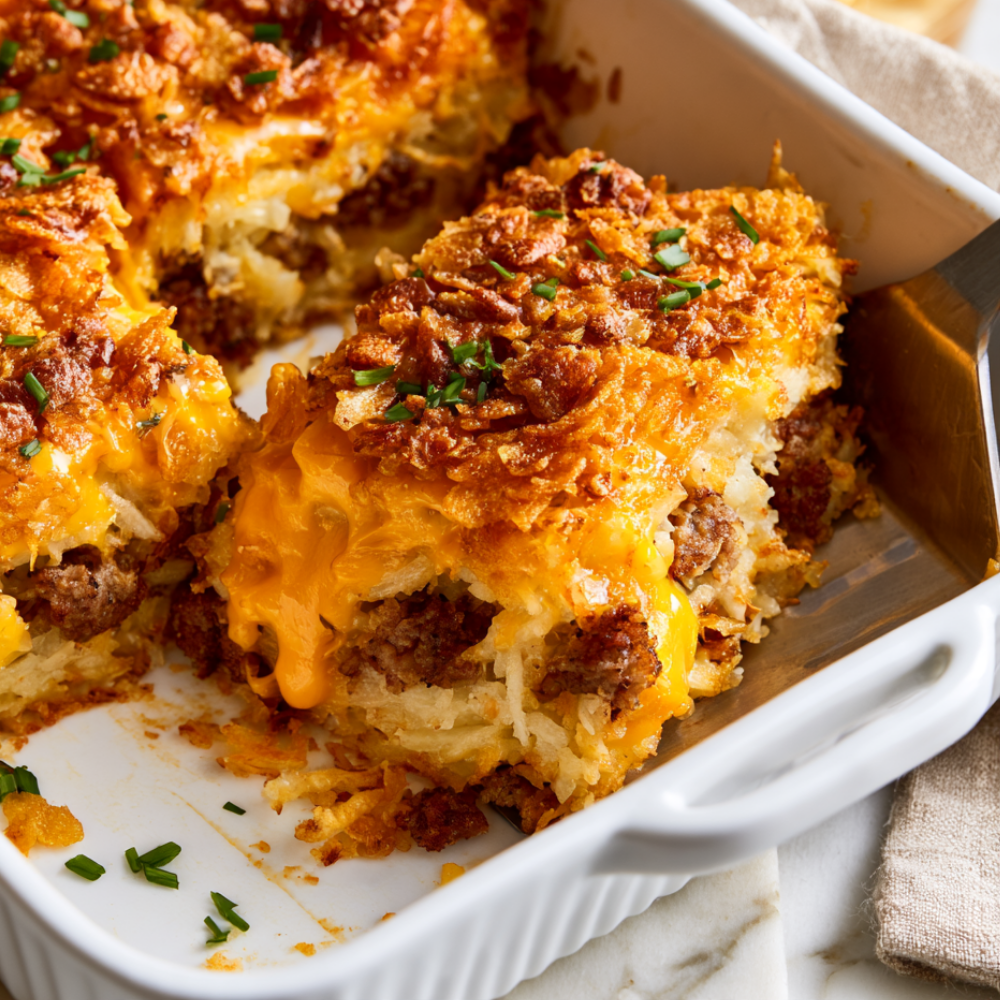
- The casserole turned out soupy. The hash browns weren’t squeezed dry, or the eggs and dairy weren’t fully combined. Squeeze the potatoes firmly in a towel and whisk the egg base until uniform.
- The topping turned soggy. The casserole was covered too long, or the hash browns released too much water. Follow the covered and uncovered timing exactly and dry the potatoes.
- The center is still wet after 55 minutes. The dish was too deep, or the oven ran cool. Use a 9×13 dish and check the oven temperature with a thermometer.
- The cornflakes burned. The dish was too close to the top element, or the uncovered bake ran too long. Bake on the middle rack and check at 18 minutes.
- The casserole tastes bland. It needs more salt, or the cheddar was mild. Use sharp cheddar and 1 tsp salt in the base. Taste the egg mixture before it goes in the dish.
- The casserole tastes too salty. The sausage and cheese were stacked. Use a lower-sodium sausage, reduce the kosher salt to ½ tsp, and taste the base before baking.
- The casserole turned out greasy. The sausage wasn’t drained, or you used too much butter. Drain the sausage on paper towels and measure the butter.
- The topping slid off. The cornflakes were not pressed gently into the top of the casserole. Press them lightly with your palm before baking.
- The casserole did not slice cleanly. It was cut while too hot. Rest 10 minutes off the heat before serving.
Easy Variations
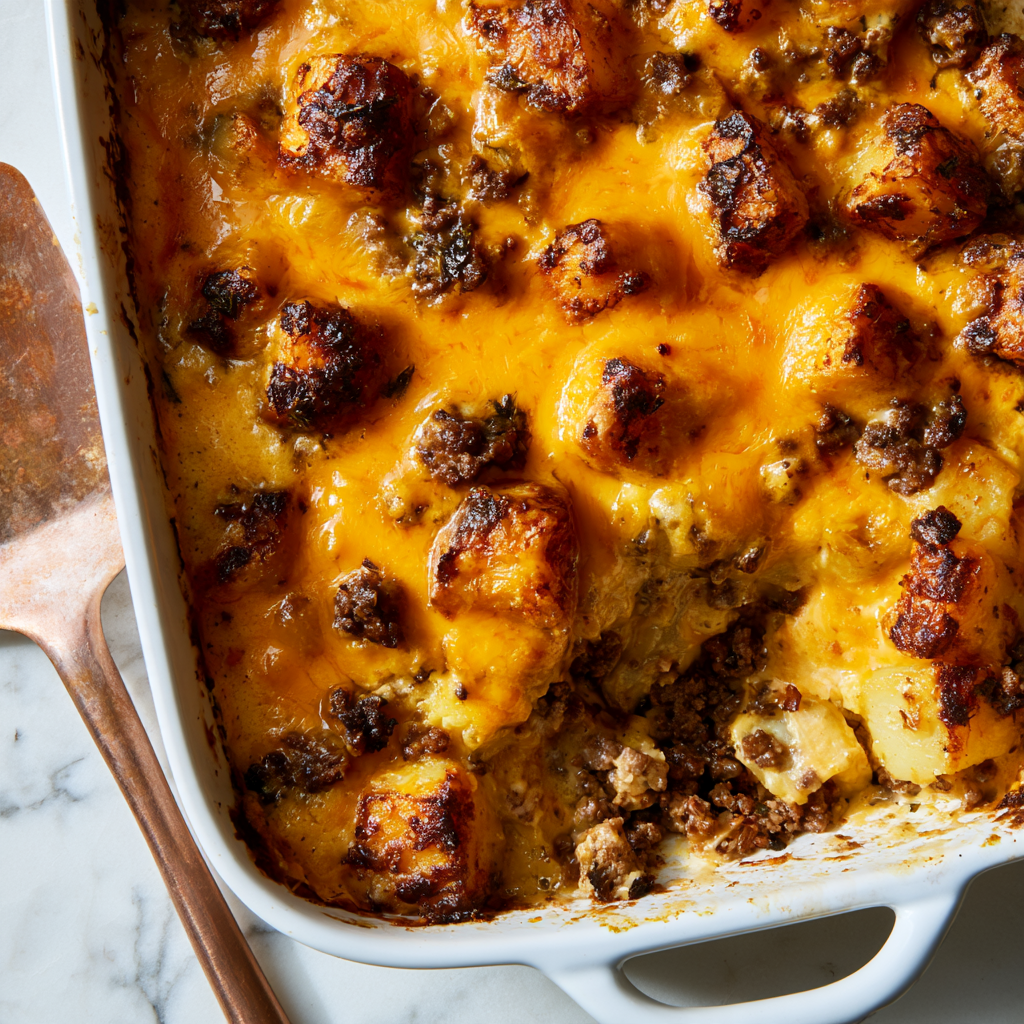
- Cracker Barrel Copycat Hash Brown Casserole. Skip the eggs and sausage entirely. Use 2 cups of sour cream, 1 can of cream of chicken soup, and ½ cup of melted butter with the hash browns and cheese. Bake as directed. Protein drops to about 9g per serving — this is the traditional version.
- Hash Brown Egg Casserole with Ham. Swap the sausage for 1½ lbs of diced ham. Skip the browning step and stir the ham straight into the egg base.
- Hash Brown Chicken Casserole. Add 2 cups of shredded rotisserie chicken to the base along with the sausage. Protein rises to about 30g per serving.
- Texas Potatoes Casserole. Swap half the cheddar for pepper jack and add 1 can of drained diced green chiles and 1 tsp of chili powder to the base.
- Simple Hash Brown Casserole. Skip the sausage and double the cheddar. Protein drops to about 16g per serving, but it works as a side dish.
- Cheesy Diced Potatoes. Swap the shredded hash browns for 30 oz of frozen diced potatoes. Bake 10 minutes longer, covered.
- Freezer Cheesy Potatoes. Freeze fully baked in individual portions. Reheat in the microwave for 2 minutes or in a 350°F oven for 20 minutes.
Storage and Food Safety
Refrigerator: Store leftovers in an airtight container for up to 4 days. Reheat covered at 325°F for 20 minutes, or in the microwave for 90 seconds per portion. The oven brings back the topping better than the microwave does.
Freezer: Freeze unbaked or fully baked for up to 3 months. Wrap tightly with plastic wrap and foil. Thaw overnight in the refrigerator before reheating. Reheat covered at 350°F for 45 minutes, then uncovered for 10 minutes.
Make Ahead: Assemble the entire casserole up to 24 hours ahead and refrigerate covered. Add 5 to 10 minutes to the covered bake time.
Food Safety: Ground sausage must reach an internal temperature of 160°F. The casserole is fully baked when the center reaches 165°F, and a knife inserted in the middle comes out clean.
Cool leftovers within 2 hours and refrigerate promptly. Reheat leftovers to 165°F. Do not leave the casserole at room temperature for more than 2 hours.
Frequently Asked Questions
How much protein is in this casserole? About 24g per serving across twelve portions, from the sausage, eggs, cottage cheese, Greek yogurt, and cheddar. A traditional sour cream and cream of chicken version lands at about 8 to 10g per serving.
Can I make this without sausage? Yes. Skip the sausage and double the cheddar. Protein drops to about 16g per serving, which works well as a side dish.
Can I use frozen hash browns without thawing them? You can, but the casserole will be wetter and the topping less crisp. Thaw and squeeze them dry for the best result.
Can I use shredded cheese from a bag? No. Pre-shredded cheese has anti-caking starch that keeps it from melting smoothly. Grate a block of sharp cheddar on a box grater.
Can I use a different cheese? Yes. Sharp cheddar is the classic. Monterey Jack, Gruyère, or a cheddar-jack blend all work.
Can I make this dairy-free? Yes. Use dairy-free cream cheese and dairy-free yogurt in the base, dairy-free cheddar, and olive oil in place of butter. Expect a slightly different texture.
Can I make this gluten-free? Yes, if the cornflakes and sausage are gluten-free. Verify the labels. Everything else in the recipe is naturally gluten-free.
Can I assemble this the night before? Yes. Assemble fully, cover, and refrigerate up to 24 hours. Bake straight from the refrigerator, adding 5 to 10 minutes to the covered bake time.
Can I freeze the casserole? Yes, up to 3 months. Freeze unbaked without the topping, or freeze fully baked and cooled. Thaw overnight in the refrigerator before reheating.
How do I reheat leftovers without softening the topping? Reheat in a 325°F oven covered for 15 minutes, then uncovered for 5 minutes. The microwave works in a pinch but softens the cornflakes.
Can I use cream of chicken soup instead of the cottage cheese and yogurt? Yes, but protein drops and the casserole turns heavier. If you want to use soup, replace the cottage cheese and yogurt with 2 cups of sour cream and 1 can of cream of chicken soup.
Can I double the recipe? Yes, in two 9×13 dishes. Do not try to fit a double batch into one pan — the center will not cook through.
More High-Protein Breakfast Recipes You’ll Love
- 6 Freezer Breakfast Burritos — 26–38g protein, make-ahead and portable
- High-Protein Scrambled Eggs with Cottage Cheese — 21g protein, 3 ingredients
- 4 Crockpot Breakfast Recipes You Set and Forget (25–32g Protein)
Conclusion
A hash brown cheesy potato casserole is one of the few dishes that genuinely belongs on a holiday breakfast table.
It feeds a crowd, can be made ahead, freezes well, and everybody takes a second scoop.
The traditional version carries about eight to ten grams of protein per serving and works as a side dish. This version turns it into a full breakfast. Eggs and browned sausage go into the base.
Blended cottage cheese and Greek yogurt replace most of the sour cream. Sharp cheddar and a buttery cornflake topping stay exactly where they belong.
Twenty-four grams of protein per serving. Feeds twelve. Assembles in twenty minutes and can be made up to 24 hours ahead or frozen for three months.
Make it once for a holiday breakfast. Make it again for a Sunday brunch. It becomes the casserole you come back to.