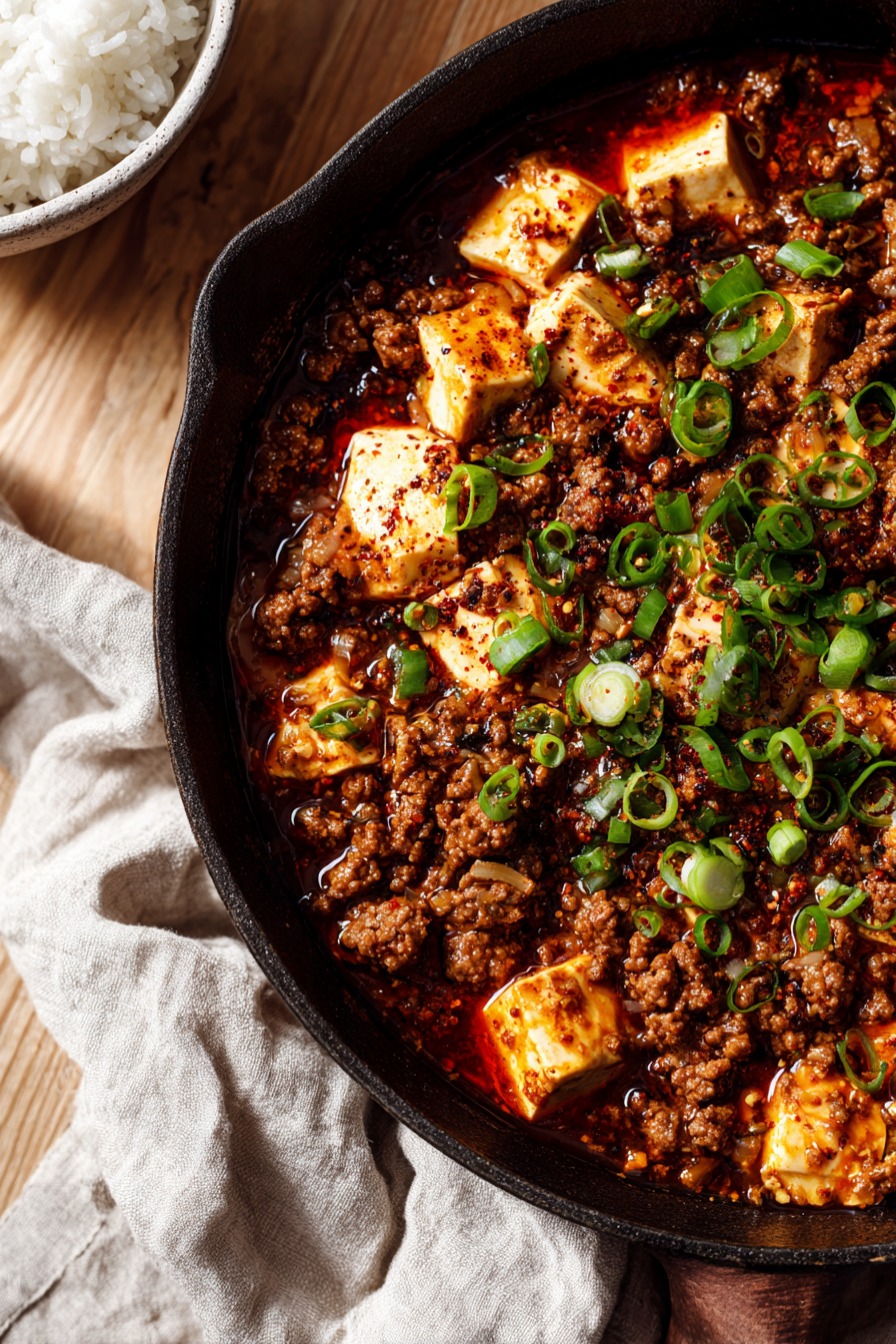

something you’d order at a chuka restaurant, made in your own kitchen in 20 minutes.
Why This Recipe Works
Mapo tofu goes wrong in three specific ways: tofu that breaks apart, a sauce that’s thin and pooled, and a flavor that’s flat or unbalanced. Here’s how this version solves each one.
1. Blanch the Tofu Before It Goes in the Pan
Tofu is fragile, and firm silken tofu especially so. A 1- to 2-minute blanch in salted water tightens the protein matrix in the tofu so the cubes hold their shape when they’re stirred into the sauce. Without that step, the tofu breaks into curds and the dish looks like scrambled eggs. The blanching water also seasons the tofu from the outside in, so it tastes like something instead of like a sponge for the sauce.
2. Bloom the Doubanjiang in the Oil Until It Turns Ruby Red
Doubanjiang (spicy chili bean paste) is the flavor backbone of mapo tofu. It needs to hit the hot oil directly and fry for about a minute — that’s when the oil turns a rich ruby red and the paste loses its raw edge. Stirred into the sauce without blooming, it tastes flat and slightly funky. The color change is the cue that it’s ready.
3. Thicken the Sauce in Two Stages, Then Set It With High Heat
The starch slurry is what turns the braising liquid into a glaze that coats the tofu. Adding it in two stages while swirling the pan (not stirring) is what keeps the tofu intact. Then a 30-second flash to high heat sets the starch emulsion so the sauce stays glossy instead of thinning out as it cools. This is the step most home cooks skip, and it’s what makes the sauce cling.
Ingredients That Matter
Firm silken or medium-firm tofu. 12 ounces, cut into ¾-inch cubes. Firm silken tofu is the traditional choice for Japanese mapo tofu — it’s soft enough to be silky but firm enough to hold its shape after blanching. Medium-firm is the next best substitute. Extra-firm tofu works but the texture is drier and less traditional.
Ground beef. 7 ounces. Traditional mapo tofu uses ground pork or ground beef, and the fat from the beef is what carries the Doubanjiang and aromatics. If you use a leaner grind, add a little extra oil when you sear it.
Doubanjiang (spicy chili bean paste). 1 to 1½ teaspoons. The flavor backbone. Adjust the heat to your taste — 1 teaspoon is mild, 1½ teaspoons is medium. Don’t substitute with other chili pastes; Doubanjiang has a fermented depth that gochujang or sriracha can’t replicate.
Tianmianjiang (sweet bean sauce). 1 tablespoon. This is what gives Japanese-style mapo tofu its sweetness. If you can’t find it, hoisin sauce is the closest substitute.
Japanese soy sauce (shoyu), sake, and chicken bouillon. The braising base. Shoyu is slightly sweeter and less salty than Chinese light soy. Sake adds a subtle rice wine depth. The chicken bouillon (granulated, sold as “garasuupu” in Japanese markets) is what gives the broth its savory backbone.
Fresh ginger and garlic. Finely minced. The aromatics that go in after the beef browns.
Green onions. Two, finely chopped, with white stems and green tops separated. The white stems cook with the aromatics; the green tops go on at the end as a garnish.
Potato starch (or cornstarch). 1 tablespoon whisked into 1 tablespoon cold water. Potato starch gives a glossier, more stable sauce than cornstarch, but cornstarch works fine.
Toasted sesame oil. 1 teaspoon, drizzled around the rim of the pan at the end. The finishing oil.
Optional: freshly ground Sichuan pepper. A small pinch, for the numbing note. Traditional Sichuan mapo tofu uses a lot; Japanese-style uses less. It’s optional.
How to Make Japanese-Style Mapo Tofu
(See the recipe card below — the steps are identical and the card is the single source of truth.)
Tips and Troubleshooting
The tofu broke apart. It wasn’t blanched, or it was stirred instead of swirled. Blanch for 1 to 2 minutes in salted water, and use a rubber spatula to push the tofu gently rather than stirring it.
The sauce is thin and pooled. The slurry wasn’t added in stages, or the sauce wasn’t flash-heated at the end. Add half the slurry, swirl, then add the rest, then turn the heat to high for 30 seconds to set the starch.
The Doubanjiang tastes raw or funky. It wasn’t bloomed. Fry it in the hot oil for a full minute until the oil turns ruby red before adding anything else.
The dish is too spicy. The Doubanjiang level is too high, or you added Sichuan pepper. Reduce the Doubanjiang to 1 teaspoon and skip the Sichuan pepper.
The dish tastes flat. The chicken bouillon was skipped, or the salt level is low. The bouillon is what gives the sauce its savory backbone, and the dish needs a real taste-and-adjust at the end.
The tofu tastes bland. It wasn’t blanched in salted water. The blanch seasons it from the outside in.
The ground beef is greasy. It wasn’t browned hard enough. Cook it until the liquid evaporates and the meat begins to crisp at the edges before adding the aromatics.
The sauce turned cloudy. The starch slurry was added to a boiling pot instead of a low-heat one. Turn the heat to LOW before adding the slurry, then flash to high at the end.
Substitutions and Swaps
Ground beef → ground pork or ground chicken thigh. Traditional mapo tofu uses pork. Ground chicken thigh is leaner and needs a little extra oil. Same quantity and method.
Firm silken tofu → medium-firm or soft tofu. Firm silken holds its shape best. Medium-firm is slightly firmer. Soft tofu breaks easily — blanch it carefully and use a very gentle touch.
Doubanjiang → gochujang + a pinch of chili flakes. Not identical, but the closest substitute if you can’t find Doubanjiang. Use 1 tablespoon gochujang and a pinch of chili flakes.
Tianmianjiang → hoisin sauce. Same quantity. Slightly sweeter and less complex, but works.
Sake → dry sherry or Chinese rice wine. Same quantity. Dry sherry is the closest substitute.
Chicken bouillon → 1 teaspoon soy sauce + ½ teaspoon sugar. Not identical, but adds the savory backbone the dish needs.
For a Sichuan-style version: increase the Doubanjiang to 2 tablespoons, add ½ teaspoon ground Sichuan pepper to the oil with the aromatics, and use Chinese light soy instead of Japanese shoyu. The dish will be much spicier and more numbing.
For a vegetarian version: skip the ground beef and use 8 ounces of finely chopped mushrooms (shiitake or cremini) plus an extra tablespoon of oil. Use vegetable broth instead of chicken broth and skip the chicken bouillon. Add an extra teaspoon of soy sauce for depth.
Storage and Reheat
Refrigerate leftovers in glass airtight containers for up to 3 days.
Reheat gently in a covered skillet over medium-low heat with 1 to 2 tablespoons of chicken broth or water to loosen the sauce smoothly without splitting the starch matrix. Reheat to 165°F.
Do not microwave. The starch matrix can break and the sauce turns grainy. A skillet is the only reliable way to reheat this.
Food safety: store leftovers within 2 hours of cooking. Discard anything left at room temperature longer than 2 hours.
Japanese-Style Mapo Tofu (Mabo Dofu)
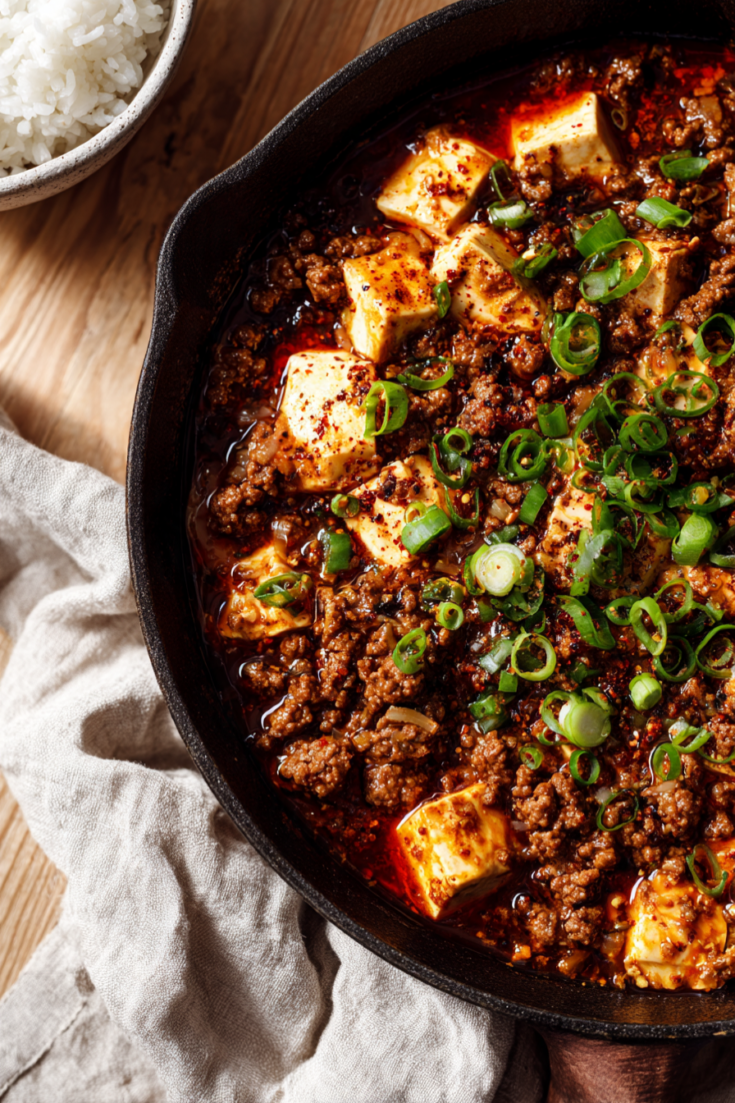
Silky, blanched tofu cubes braised with caramelized ground beef in a rich, savory sweet-and-spicy umami glaze — 32g of protein per serving.
Ingredients
Tofu Blanching and Protein Base
- 350g (12 oz) firm silken or medium-firm tofu, cut into ¾-inch cubes
- 200g (7 oz) ground beef (or ground pork, or ground chicken thigh)
- 1 teaspoon fine sea salt (for the blanching water)
Aromatic Pan Base
- 1 tablespoon neutral cooking oil (avocado or canola)
- 1 tablespoon fresh ginger, finely minced
- 2 cloves garlic, finely minced
- 2 green onions, finely chopped (white stems for pan cooking, green tops reserved for finishing)
- 1 to 1½ teaspoons Doubanjiang (spicy chili bean paste; adjust heat to taste)
Umami Braising Sauce
- ¾ cup low-sodium chicken broth (or bone broth for higher protein)
- 1 tablespoon Japanese soy sauce (shoyu)
- 1 tablespoon Japanese sake
- 1 tablespoon Tianmianjiang (sweet bean sauce)
- 1 teaspoon sugar
- 1 teaspoon granulated chicken bouillon
Slurry and Finish
- 1 tablespoon potato starch (or cornstarch) + 1 tablespoon cold water, whisked into a slurry
- 1 teaspoon toasted sesame oil
- Optional: a pinch of freshly ground Sichuan pepper
Instructions
- Pre-Blanch the Tofu: Bring 4 cups of water to a gentle simmer in a saucepan with 1 teaspoon of salt. Slide in the diced tofu cubes and simmer gently 1 to 2 minutes. Turn off the heat and leave the tofu floating in the warm water until ready to use. Blanching tightens the protein matrix and prevents the tofu from breaking in the pan.
- Sear the Beef: Heat the neutral oil in a large skillet or wok over medium-high heat. Add the ground beef, breaking it apart with a spatula. Cook 3 to 4 minutes, until the liquid evaporates and the meat begins to crisp and brown at the edges.
- Bloom the Aromatics and Paste: Add the minced garlic, ginger, and white parts of the green onions to the crisp beef. Stir-fry 30 seconds until fragrant. Add the Doubanjiang directly to the oil and stir-fry 1 minute until the oil turns a rich ruby red.
- Braise in the Sauce: Stir in the Tianmianjiang, soy sauce, sake, sugar, chicken bouillon, and chicken broth. Bring the mixture to a rapid boil. Gently drain the warm tofu cubes and slide them into the bubbling sauce. Reduce the heat to medium, cover lightly, and simmer 3 minutes so the tofu absorbs the sauce.
- Thicken and Glaze: Turn the heat to LOW. Whisk the starch slurry again, then pour half into the pan while gently swirling the skillet (use a rubber spatula to push the tofu gently without cutting the cubes). Add the remaining slurry until the sauce coats the back of a spoon. Increase the heat to HIGH for 30 seconds to set the starch emulsion.
- Finish and Serve: Drizzle the toasted sesame oil around the rim of the pan. Scatter the reserved green onion tops (and optional Sichuan pepper) over the top, ladle into bowls over hot steamed rice, and serve immediately.
Notes
Notes
Blanching the tofu in salted water for 1 to 2 minutes is the step that keeps the cubes intact — without it, the tofu breaks apart when it hits the sauce.
Bloom the Doubanjiang in the hot oil until it turns ruby red before anything else goes in; that's where the color and depth come from. Add the starch slurry to a low-heat pan in two stages, swirling rather than stirring, then flash the heat to high for 30 seconds to set the sauce.
Leftovers keep 3 days in the fridge; reheat in a covered skillet with a splash of broth, never in the microwave. Nutrition is an estimate and varies by broth and bouillon brands.
Estimated per serving: 390 calories · 32g protein · 14g carbs · 22g fat · 3g fiber · 820mg sodium
Frequently Asked Questions
What’s the difference between Japanese-style mapo tofu and Sichuan mapo tofu?
Japanese-style (mabo dofu) is milder, slightly sweeter, and less numbing than the Sichuan original. It uses less Doubanjiang, adds sweet bean sauce (tianmianjiang), and skips or reduces the Sichuan peppercorns. The base is Japanese — sake, shoyu, and chicken bouillon instead of Chinese light soy and rice wine.
Can I use ground pork instead of ground beef?
Yes. Ground pork is actually the traditional choice for mapo tofu. Same quantity and method.
Can I use firm tofu instead of silken?
Yes. Firm tofu holds its shape even better than silken, but the texture is less silky. Medium-firm is the best middle ground.
What is Doubanjiang, and can I substitute it?
Doubanjiang is a fermented spicy chili bean paste from Sichuan. It’s the flavor backbone of mapo tofu and there’s no perfect substitute. Gochujang plus a pinch of chili flakes is the closest swap.
What is tianmianjiang?
Tianmianjiang is a sweet fermented bean sauce used in northern Chinese cooking. It’s what gives Japanese-style mapo tofu its sweetness. Hoisin sauce is the closest substitute.
Can I make this vegetarian?
Yes. Skip the ground beef and use 8 ounces of finely chopped mushrooms (shiitake or cremini) plus an extra tablespoon of oil. Use vegetable broth instead of chicken broth, skip the chicken bouillon, and add an extra teaspoon of soy sauce for depth.
Why did my tofu break apart?
It wasn’t blanched, or it was stirred instead of swirled. Blanch for 1 to 2 minutes in salted water and use a rubber spatula to push the tofu gently.
How do I reheat leftovers?
In a covered skillet over medium-low heat with 1 to 2 tablespoons of chicken broth or water, stirring gently until heated through. Don’t use the microwave — the starch matrix can break and the sauce turns grainy.
More Ground Beef and Asian Dinner Recipes You’ll Love
Beef Yaki Udon With Teriyaki — 37g protein, one pan, 30 minutes.
One-Pot Crispy Chicken and Rice — 35g protein, one Dutch oven, 1 hour.
Thai Basil Chicken — 55g protein, one wok, 17 minutes.
Hawaiian Chicken Crockpot — 34g protein, sticky pineapple glaze, 10 minutes of prep.
15 Easy Chicken Crockpot Recipes for Busy Families — the full collection, organized by night-type.
High-Protein Slow Cooker Dinners — ten weeknight dinners organized by cook time.
Closing
I’ve made this Japanese-style mapo tofu more times than I can count, and the two things that changed everything for me were blanching the tofu before it goes in the pan and blooming the Doubanjiang until the oil turns ruby red. The first batch I made had the flavor right and the texture wrong — the tofu broke apart and the sauce was thin. Those two fixes turned it into something that tastes like a chuka restaurant bowl.
If you make it Sichuan-style with more Doubanjiang or swap in ground pork, let me know how it turns out in the comments.