Maybe you’ve made the same red-sauce lasagna for years, and it’s fine — reliably fine — but lately you’ve wanted something that feels new.
Or maybe lasagna is a family favorite, except for one person at the table who’s never been convinced by tomatoes.
Either way, this chicken alfredo lasagna is the answer: a white, creamy, garlicky lasagna that’s lighter than most but still unmistakably alfredo, and satisfying in the way that makes everyone go back for a second square.
It’s the version I make when I want lasagna to feel like a treat without hours in the kitchen.
The sauce is scratch-made from a simple roux, chicken broth, and 2% milk, so it tastes like garlic and parmesan rather than the inside of a jar — and it stays silky through the whole bake.
The ricotta layer is whipped with an egg, parmesan, and a little spinach, so it sets into something you can actually cut, and the top gets a crisp panko-parmesan crust that gives every bite a little crunch against all that cream.
What makes it work is the egg in the ricotta. One large egg, fully whipped in, is the difference between a slice that holds its shape on the spatula and one that doesn’t.
It’s a small step, and it’s the reason I stopped second-guessing this recipe after the first test.
It feeds eight, reheats beautifully, and works for a Sunday dinner and a Tuesday lunchbox alike.
Why This Recipe Works
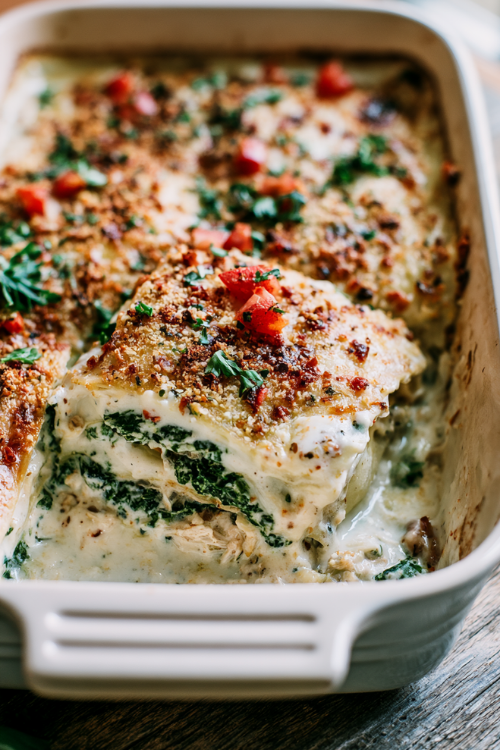
The spinach squeeze is non-negotiable. Frozen chopped spinach holds a lot of water. If you boil it and mix it wet into ricotta, that water becomes steam inside the lasagna, and steam liquefies your center layers. Wrapping the thawed spinach in a clean kitchen towel and wringing it out until it feels almost dry is the single biggest structural fix in this recipe.
The egg binds the ricotta into a cuttable matrix. Ricotta alone is loose and grainy. Whipped with an egg, finely grated parmesan, garlic powder, salt, pepper, and a pinch of nutmeg, it sets during baking into a firm, sliceable layer. The nutmeg is traditional in white lasagnas for a reason — it rounds out the dairy without announcing itself.
A scratch roux alfredo replaces the jarred stuff. Jarred alfredo is an oil-and-milk-solid emulsion held together by stabilizers. An hour at 350°F breaks that emulsion and pools grease on top of the cheese. A flour-roux sauce built on chicken broth and 2% milk is a real emulsion that thickens and holds. It also drops the fat dramatically — about 38g less per slice than the jarred version.
No-boil noodles absorb the residual moisture. Oven-ready lasagna sheets are dry and thirsty. As they bake, they pull moisture from the sauce and spinach, which is exactly what you want in a white lasagna. Traditional noodles par-cooked for 4 minutes work too, but no-boil is the easier and more reliable choice.
The panko-parmesan top gives the slice a crisp edge. A white lasagna is soft from top to bottom — creamy sauce, soft ricotta, melted mozzarella, tender chicken. Toasting panko and parmesan over the top for the last 10 minutes adds the one texture the dish is missing. It’s a small step that changes how the whole bite reads.
The rest time is a structural step, not a suggestion. Fifteen to twenty minutes out of the oven lets the starch and cheese matrix firm up. Cut it early, and you’ll get the slide-apart slice you were trying to avoid.
Ingredients That Matter
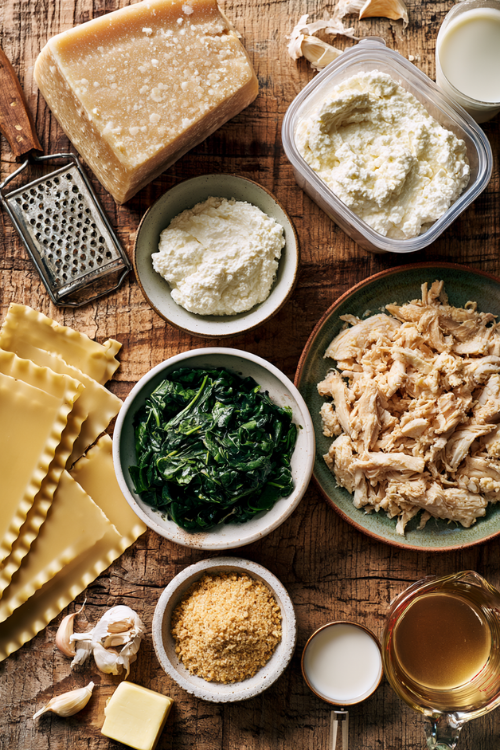
Frozen chopped spinach, squeezed bone-dry. If you skip the squeeze — or just drain it in a colander — you’re adding roughly half a cup of water back into the center of the lasagna. The slices will slide. Wrap it in a kitchen towel and wring it until it stops dripping, then wring it again.
Part-skim ricotta, whipped with an egg. Full-fat ricotta is looser and releases more whey; part-skim holds better, and the egg sets it further. If you use full-fat, expect a slightly softer set and rest the lasagna the full 20 minutes.
Freshly grated Parmigiano-Reggiano from a block. Pre-grated parmesan is coated in cellulose to prevent clumping, and it doesn’t melt into the sauce the same way. It also varies wildly in salt content. Grate it yourself, and taste the alfredo before you layer — you may need less salt than the recipe calls for.
How to Make It
1. Thaw and squeeze the spinach. Thaw a 10-oz package of frozen chopped spinach, then wrap it in a clean kitchen towel and wring it out over the sink until it feels dry and clumps together. Set aside.
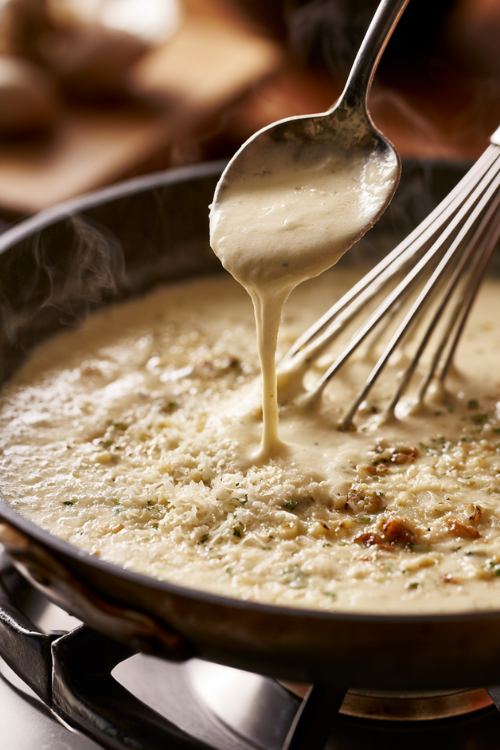
2. Build the scratch alfredo. Melt 2 tablespoons of unsalted butter in a saucepan over medium heat. Add 4 cloves of finely minced garlic and sauté for 1 minute, until fragrant but not browned. Whisk in 2 tablespoons of all-purpose flour and cook for 1 minute to remove the raw flour taste. Slowly whisk in 1½ cups low-sodium chicken broth and 1½ cups 2% milk. Simmer for 3 to 4 minutes, whisking, until the sauce thickens enough to coat the back of a spoon. Reduce the heat to low and whisk in 3 oz of light cream cheese, 1 cup of freshly grated Parmigiano-Reggiano, ½ teaspoon garlic powder, ½ teaspoon kosher salt, ½ teaspoon black pepper, and a pinch of ground nutmeg. Whisk until velvety and smooth, then remove from the heat. Taste and adjust salt — parmesan brands vary.
3. Mix the chicken. In a medium bowl, toss 1 lb cooked, shredded, or finely diced chicken breast with 1 cup warm Alfredo sauce. Set aside.
4. Whip the ricotta mixture. In a second bowl, combine 15 oz part-skim ricotta, 1 large egg, ½ cup finely grated Parmigiano-Reggiano, the squeezed-dry spinach, ½ teaspoon garlic powder, ½ teaspoon kosher salt, and ¼ teaspoon black pepper. Stir until thoroughly combined and evenly green.
5. Preheat and grease. Preheat the oven to 375°F (190°C). Lightly grease a 9×13-inch baking dish.
6. Layer the lasagna. Spread ½ cup of Alfredo sauce over the bottom of the dish. Lay down 3 to 4 no-boil lasagna sheets, overlapping slightly. Spread half the ricotta-spinach mixture evenly over the noodles, then sprinkle with ¾ cup of shredded part-skim mozzarella. Add a second layer of noodles, then spread the chicken-alfredo mixture evenly across. Add a third noodle layer, spread the remaining ricotta-spinach mixture, spoon half the remaining Alfredo over top, and sprinkle with ¾ cup mozzarella. Add the final noodle layer, pour the remaining Alfredo evenly over to coat every noodle, and finish with the remaining 1 cup mozzarella.
7. Make the panko topping. In a small bowl, combine ½ cup panko breadcrumbs, 2 tablespoons finely grated Parmigiano-Reggiano, and 1 tablespoon olive oil. Stir until the crumbs are evenly moistened. Set aside.
8. Bake covered. Cover the dish tightly with aluminum foil — spray the underside with cooking spray so the cheese doesn’t stick — and bake at 375°F for 30 minutes.
9. Add the topping and brown. Remove the foil, scatter the panko mixture evenly over the top, and bake uncovered for 15 minutes, until the top is golden, the crumbs are crisp, and the sauce is bubbling at the edges.
10. Rest before cutting. Remove from the oven and let rest undisturbed for 15 to 20 minutes. This is what firms the layers so each slice cuts cleanly. Garnish with 2 tablespoons fresh chopped flat-leaf parsley and, if you like, diced fresh tomatoes. A squeeze of lemon over the top brightens the whole slice.
Tips and Troubleshooting
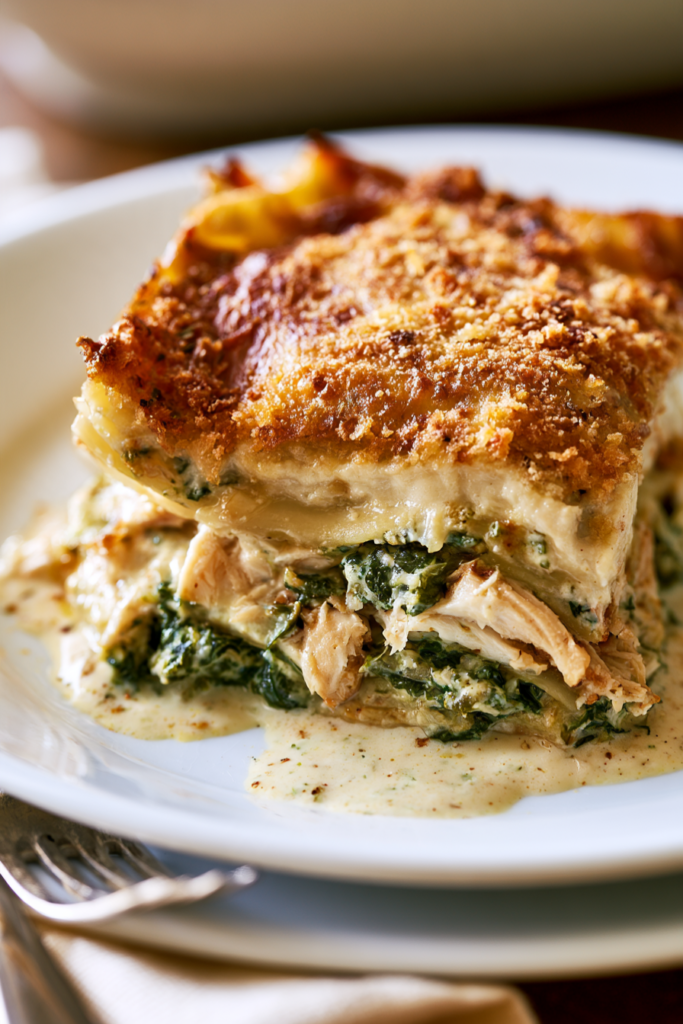
The center is watery and the slices slide. You didn’t squeeze the spinach dry enough, or you cut the lasagna before it rested. Squeeze the spinach in a towel until it stops dripping, and wait the full 15 to 20 minutes before cutting.
The alfredo sauce broke and pools oil on top. The heat was too high when you added the cream cheese, or the sauce boiled after you added the dairy. Keep it on low, whisk constantly, and pull it off the heat as soon as it’s smooth.
The ricotta layer tastes flat and rubbery. It needed more seasoning and the egg binder. Whip in the parmesan, garlic powder, nutmeg, salt, and pepper until fully combined — don’t just stir them in.
The top is pale, and the cheese never browned. You didn’t remove the foil early enough, or your oven runs cool. Remove the foil at the 30-minute mark, add the panko, and give it the full 15 minutes uncovered.
The noodles are still firm after baking. No-boil sheets need moisture to hydrate. Make sure every top noodle is coated in alfredo before baking, and don’t skip the covered bake — that traps the steam the noodles need.
It’s too salty. Count your sources: broth, parmesan (twice), mozzarella, ricotta, and added salt. Use low-sodium broth, grate your own parmesan, and taste the alfredo before layering. If it’s already assembled and tastes salty, a squeeze of lemon at serving helps balance it.
It dried out on reheat. Reheat covered with a splash of milk or broth, not uncovered. The sauce needs moisture to come back.
A Few Honest Notes
I haven’t tested this with a dairy-free ricotta or a cashew-based alfredo, so I can’t vouch for how the layers set without the egg and dairy. If you try it, I’d love to hear how it turns out.
Storage and Make-Ahead
Refrigerate leftovers in an airtight container for up to 4 days.
Reheat covered at 350°F with a splash of milk or broth, or microwave individual portions in 90-second bursts with a damp paper towel over the top.
The lasagna freezes well for up to 3 months — wrap slices individually or freeze the whole dish before baking, thaw overnight in the refrigerator, and reheat covered.
It’s best within the first two days, but it holds up well enough that I’ve happily eaten it on day four. Don’t boil it after the dairy is in — reheat gently.
High-Protein Chicken Alfredo Lasagna
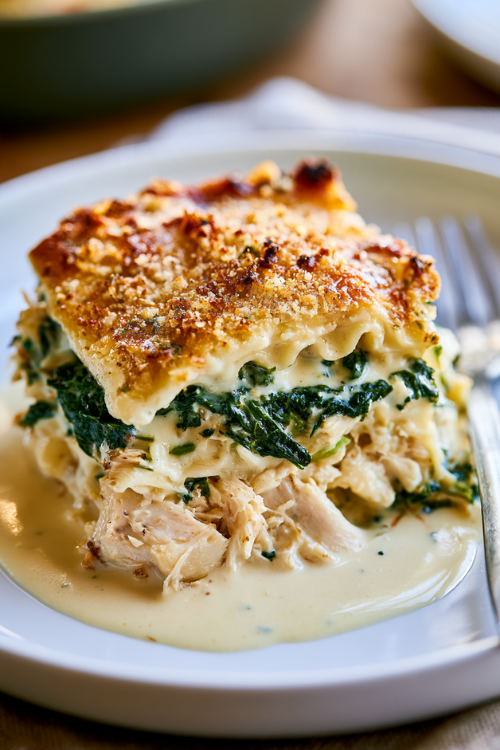
A white lasagna with scratch-made garlic parmesan alfredo, egg-bound ricotta and spinach, tender chicken, and a crisp panko top — structured enough to cut clean slices.
Ingredients
High-Protein Scratch Alfredo Sauce
- 2 tbsp unsalted butter
- 4 cloves garlic, finely minced
- 2 tbsp all-purpose flour
- 1½ cups low-sodium chicken broth
- 1½ cups 2% milk
- 3 oz light cream cheese
- 1 cup Parmigiano-Reggiano, freshly grated
- ½ tsp garlic powder
- ½ tsp kosher salt
- ½ tsp freshly ground black pepper
- Pinch of ground nutmeg
For Garlic-Herb Ricotta & Spinach Layer
- 1 package (10 oz) frozen chopped spinach, thawed and squeezed bone-dry
- 15 oz part-skim ricotta cheese
- 1 large egg
- ½ cup Parmigiano-Reggiano, finely grated
- ½ tsp garlic powder
- ½ tsp kosher salt
- ¼ tsp black pepper
For Assembly & Topping
- 12 sheets oven-ready (no-boil) lasagna noodles
- 1 lb cooked chicken breast, shredded or finely diced
- 2½ cups (10 oz) part-skim mozzarella, shredded, divided
- ½ cup panko breadcrumbs
- 2 tbsp Parmigiano-Reggiano, finely grated
- 1 tbsp olive oil
- 2 tbsp fresh flat-leaf parsley, chopped
- Diced fresh tomatoes and a lemon wedge, optional for serving
Instructions
- Thaw the spinach, wrap it in a clean kitchen towel, and wring it out until dry. Set aside.
- Melt butter in a saucepan over medium heat. Add garlic and sauté for 1 minute. Whisk in flour and cook 1 minute. Slowly whisk in broth and milk; simmer 3–4 minutes until thickened. Reduce heat to low and whisk in cream cheese, 1 cup Parmesan, garlic powder, salt, pepper, and nutmeg until smooth. Remove from heat and taste for salt.
- Toss the chicken with 1 cup of the Alfredo sauce in a bowl.
- In a second bowl, combine the squeezed spinach, ricotta, egg, ½ cup Parmesan, garlic powder, salt, and pepper, and mix until thoroughly combined.
- Preheat oven to 375°F (190°C) and grease a 9×13-inch baking dish.
- Spread ½ cup Alfredo on the bottom. Layer noodles, half the ricotta-spinach mixture, and ¾ cup mozzarella. Add noodles, the chicken-alfredo mixture, then noodles, the remaining ricotta-spinach mixture, half the remaining alfredo, and ¾ cup mozzarella. Top with the final noodles, the remaining Alfredo, and the remaining 1 cup mozzarella.
- Combine panko, 2 tbsp parmesan, and olive oil; set aside.
- Cover tightly with foil (spray the underside) and bake for 30 minutes. Remove foil, scatter the panko topping, and bake uncovered for 15 minutes, until golden and bubbling.
- Rest 15–20 minutes before cutting. Garnish with parsley and tomatoes, and finish with a squeeze of lemon if you like.
Notes
Notes: Refrigerate for up to 4 days; reheat covered with a splash of milk. Freezes for up to 3 months. Don't boil after adding the dairy. Nutrition is an estimate.
Nutrition (per serving, estimated): 560 calories, 52g protein, 44g carbs, 20g fat, 3g fiber, 720mg sodium.
FAQ
Can I use rotisserie chicken instead of cooking chicken breast? Yes — pull the meat from a rotisserie chicken and shred it. You’ll need about 3 cups. Skip any heavily seasoned skin, and taste the alfredo before layering since rotisserie chicken is already salty.
Can I make this ahead of time? Assemble it up to 24 hours ahead, cover, and refrigerate. Add 10 minutes to the covered bake time since it goes in cold. You can also freeze it unbaked — thaw overnight before baking.
Can I use traditional lasagna noodles instead of no-boil? Yes. Par-cook them for 4 minutes, drain, and lay them out on a towel so they don’t stick. No-boil sheets are easier and absorb moisture more reliably, but traditional noodles work.
Why did my lasagna come out watery? Almost always the spinach. It has to be squeezed in a towel until dry, not just drained. The second most common cause is cutting it before the rest time — the layers need 15 to 20 minutes to set.
Can I make this without the panko topping? Yes, it’s optional. The lasagna works without it, but the panko is what gives the slice a crisp edge against all the creamy layers. If you skip it, add a squeeze of lemon and extra parsley at serving.
Is this lasagna gluten-free? Not as written. You’d need gluten-free lasagna sheets, gluten-free panko, and a cornstarch slurry in place of the flour roux. I haven’t tested that version, so I can’t vouch for the texture.
More Recipes You’ll Love
- High-Protein Lasagna with Cottage Cheese (Tastes Like Ricotta)
- The Crockpot Lasagna with Ricotta That Tastes Like It Simmered All Day
- Lasagna Roll Ups Recipe (Make Ahead & Freezer Friendly, 32g Protein!)
- The Best Eggplant Lasagna Recipe — Extra Cheesy, No Noodles, 22g Protein
Closing
The two techniques that make this work are the bone-dry spinach squeeze and the egg-bound ricotta — everything else is flavor.
Get those right, and you’ll get slices that hold their shape on the spatula, which is the thing white lasagnas usually can’t do.
It’s the version I’d hand you first if you told me your last chicken lasagna turned into a puddle. Make it once, and tell me how the panko top came out.