There is a moment on Christmas Day that every home cook knows. The table is set. The good plates are out. Somewhere between twelve and fifteen people are holding glasses of wine, waiting, and the door of the oven opens. You are holding the roast — a hundred-dollar piece of beef, the actual centerpiece of the holiday, the thing everyone has been smelling for two hours. And every single person in that room is about to find out whether you nailed it.
That is the deal with prime rib. It is not just dinner. It is the dish you volunteered to make for the holiday feast. It is the one people photograph. It is the one your father-in-law will bring up again next year, either as the best roast he has ever had or as the one that came out gray. Nobody remembers the green beans. Everybody remembers the prime rib.
And the worst part is that the stakes are completely out of proportion to the technique. Prime rib is a simple roast. Salt it, cook it, rest it, slice it. Four steps. But the most common recipe on the internet asks you to do math based on how long your roast sat on the counter, blast it at 500°F, turn the oven off, and then not look at it for two hours while hoping your oven holds heat like the recipe assumes. If your oven runs cool, or somebody opens the door, or the roast was still cold in the middle when it went in, you carve into a gray ring around a raw center in front of everyone.
This version removes the gamble. It uses a 24-hour dry brine so the seasoning reaches the center of the roast. It cooks low and slow at 250°F to 120°F, monitored with a probe thermometer instead of a timer. It rests, then gets a ten-minute blast at 500°F to build a crackling herb butter crust. And it finishes with a red wine au jus made from the drippings.
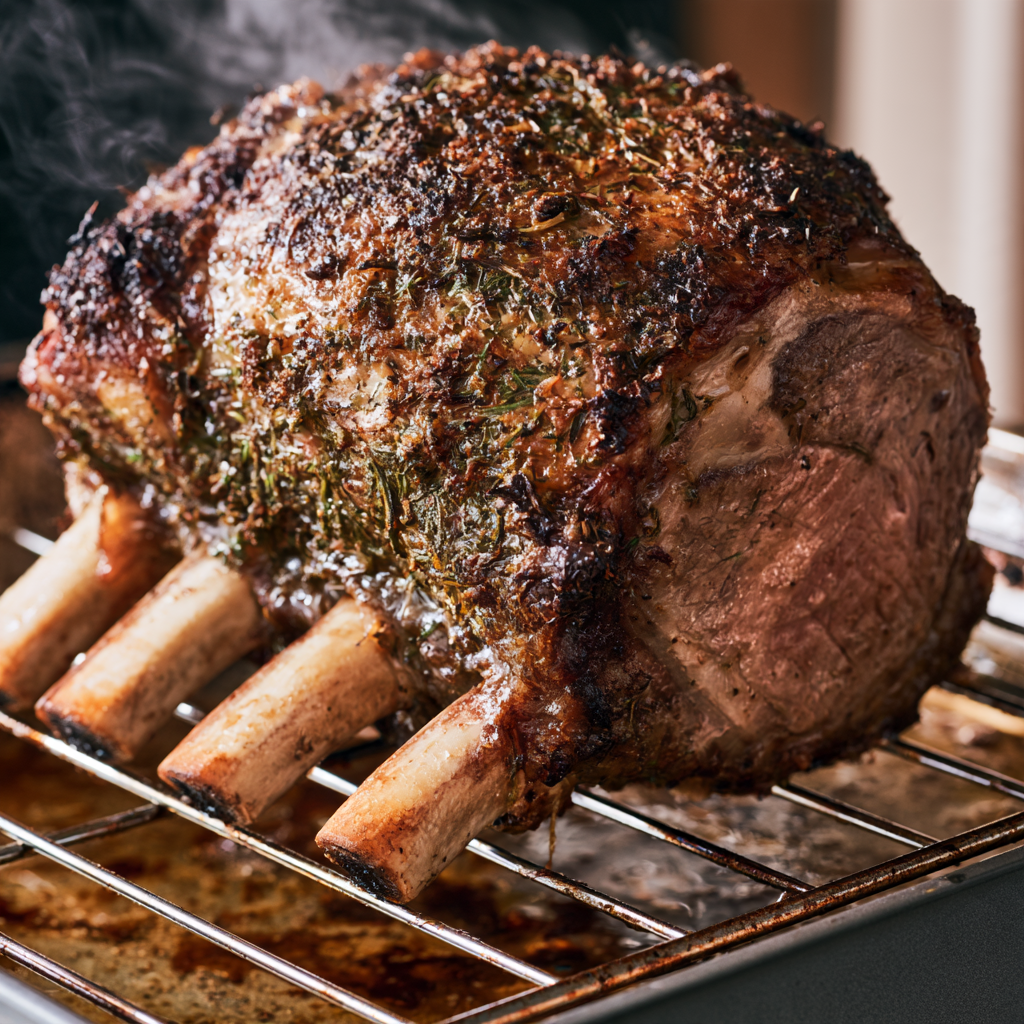
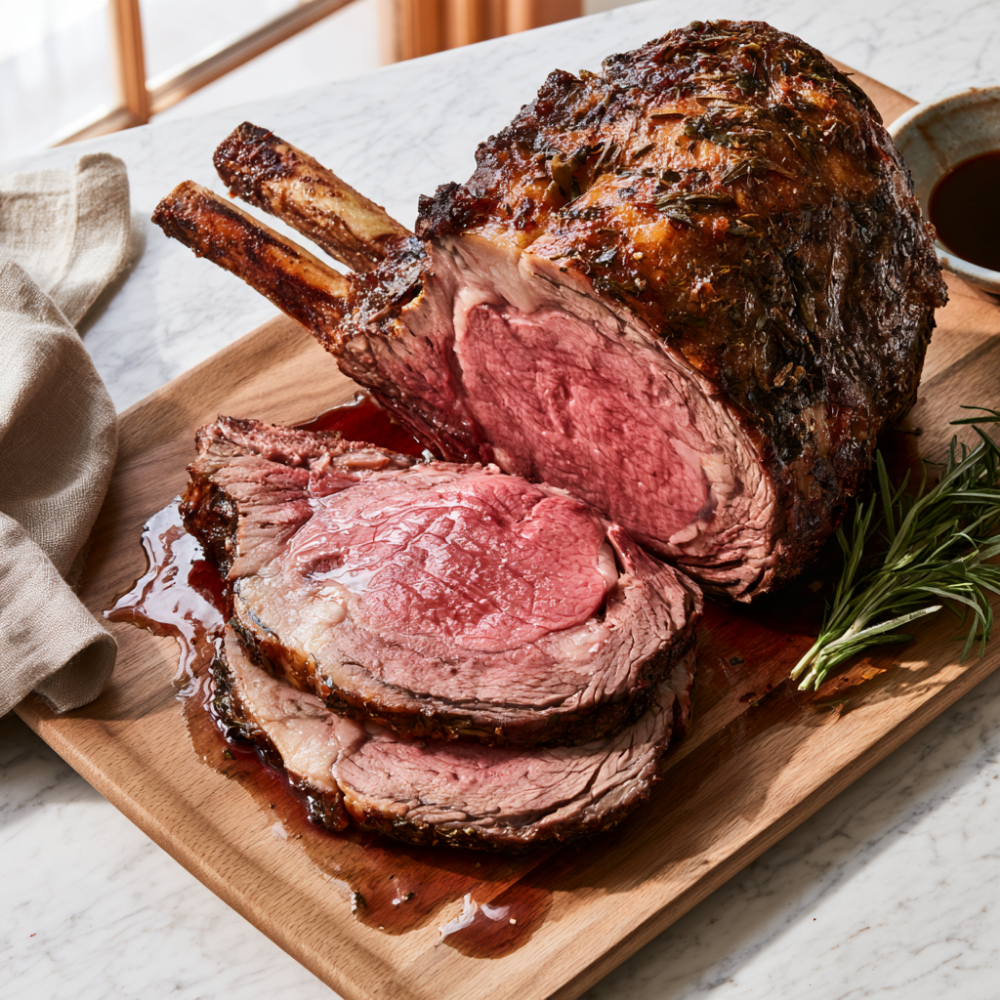
The result is edge-to-edge pink from the crust inward. Almost no gray band. A roast that is seasoned all the way through, that slices clean, and that tastes like the version you would pay eighty dollars a plate for.
Fifty grams of protein per serving. Herb butter, rosemary, thyme, and sage under the fat cap. Garlic studded through the meat. It is holiday-ready, and it is built so you do not have to hold your breath when the door opens.
Why This Recipe Works
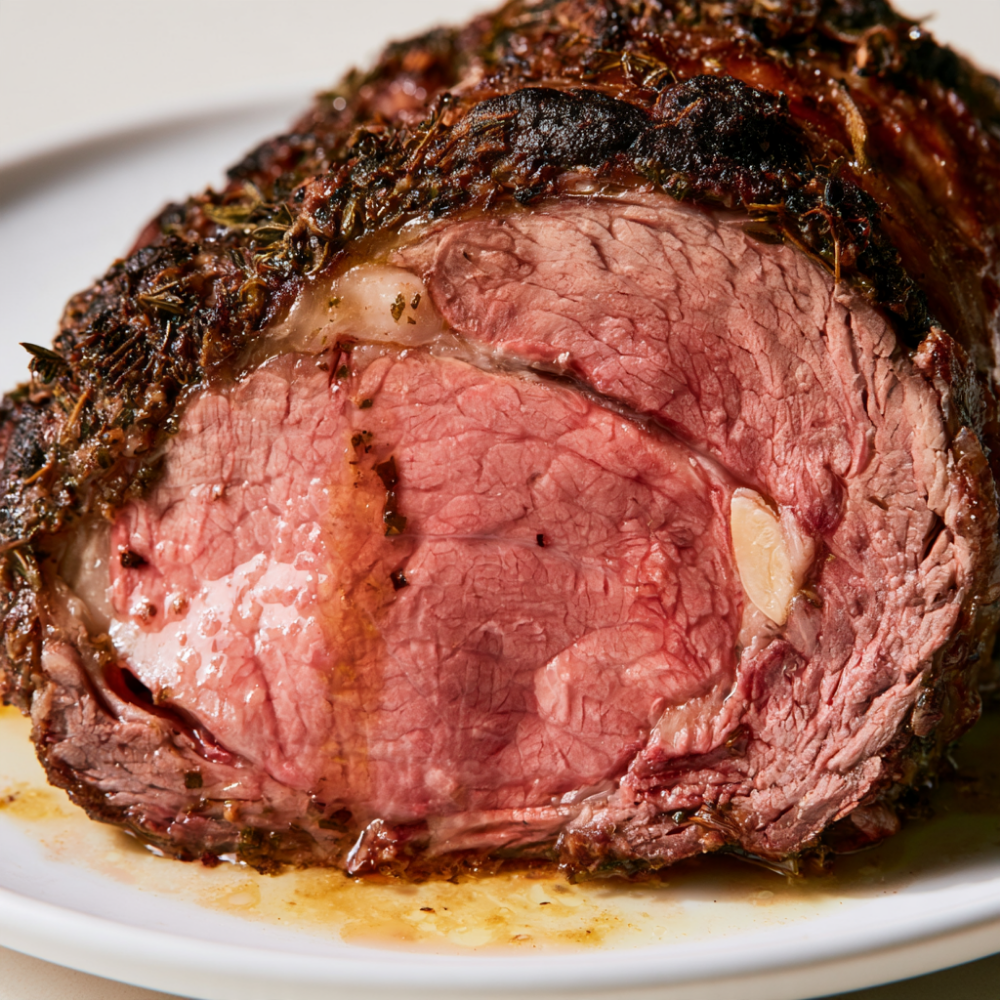
The protein math is honest. A 6 lb bone-in roast yields about 4.5 lb of edible meat and roughly 50 g of protein per serving across 8 portions.
A 24-hour dry brine seasons the roast all the way through. Salting the surface and letting it sit uncovered in the fridge draws moisture out, dissolves the salt, and pulls it back in as a concentrated brine. It also dries the surface, which is what gives you a crust.
The reverse sear is the most reliable method for doneness. Low oven first, high heat last. The roast climbs slowly and evenly to 120°F with almost no gray band, then the blast builds crust without cooking the interior further.
Cooking to temperature beats cooking to a timer. The weight-times-five formula assumes a specific oven. A probe thermometer works in every oven, every time.
Herb butter goes under the fat cap, not just on top. Sliding compound butter between the meat and the fat cap bastes the roast from the inside as the fat renders.
Studding garlic slivers into the meat distributes flavor. Garlic in the butter only flavors the surface. Garlic inside the roast seasons every slice.
Dijon mustard in the butter helps the herbs adhere. It also adds a subtle tang that cuts the beef’s richness.
Fresh rosemary, thyme, and sage are the holiday trio. Dried herbs work, but fresh ones hold up to a long roast and smell like Christmas.
Leave the fat cap on and facing up. It bastes the roast as it renders and protects the meat underneath.
Resting loosely tented, not tightly wrapped, preserves the crust. Foil pressed against a hot roast steams the crust soft.
Carryover cooking adds 5–10°F during the rest. Pull at 120°F for medium-rare. It finishes at 128–132°F.
The drippings plus red wine make a real au jus. Deglazing the pan with wine and broth gives you a sauce that tastes like the roast, not like a packet.
Herb Butter Prime Rib Roast
A dry-brined, reverse-seared prime rib roast with rosemary-garlic herb butter, finished with a red wine au jus. Edge-to-edge pink, holiday-ready, and cooked to temperature instead of by timer.
For the Roast
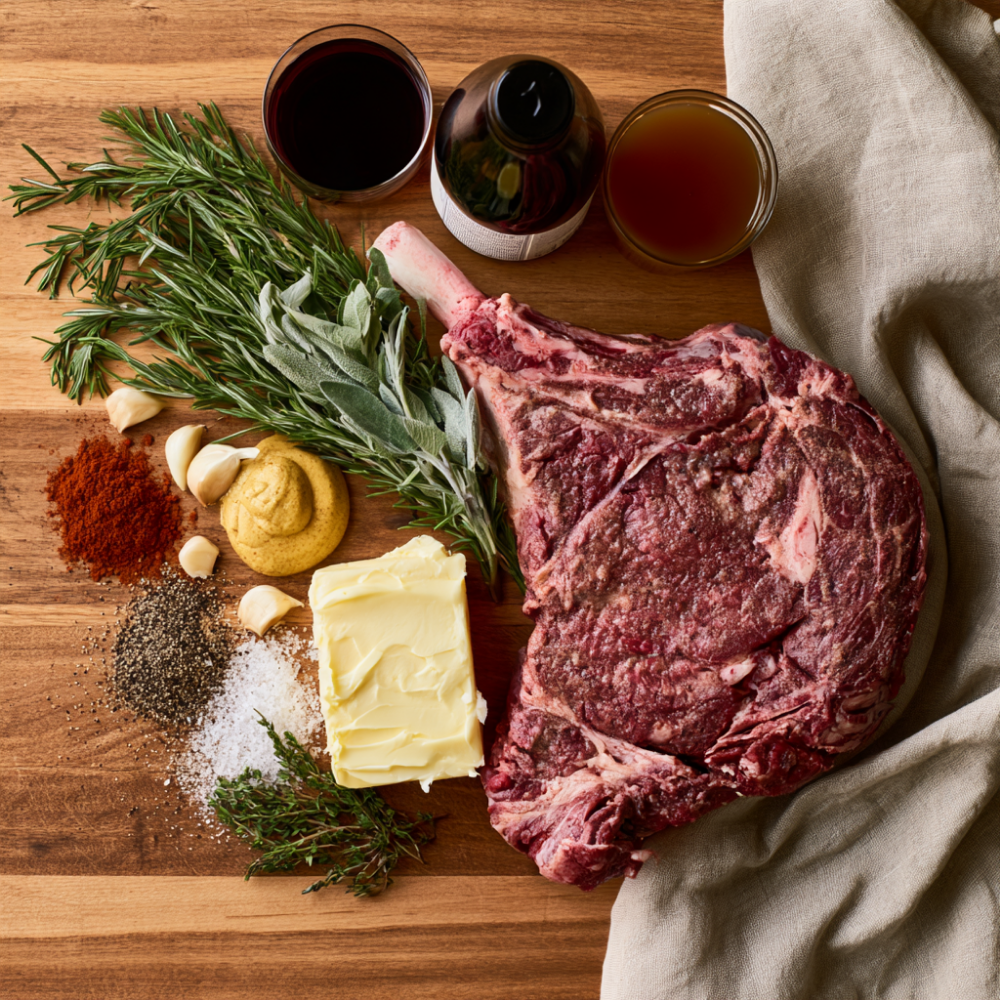
- 1 6 lb bone-in prime rib roast, 3 bones, fat cap intact
- 1 tbsp kosher salt per pound of roast (about 6 tbsp total)
- 1 tbsp coarse black pepper
- 6 cloves garlic (cut into thin slivers)
For the Herb Butter
- ½ cup unsalted butter (softened)
- 2 tbsp fresh rosemary (finely chopped)
- 1 tbsp fresh thyme leaves
- 1 tbsp fresh sage (finely chopped)
- 4 cloves garlic (grated or minced)
- 1 tbsp Dijon mustard
- 1 tsp smoked paprika
- 1 tsp kosher salt
- ½ tsp black pepper
For the Red Wine Au Jus
- 1 cup dry red wine
- 2 cups low-sodium beef broth
- 2 sprigs fresh rosemary
- 3 sprigs fresh thyme
- 1 tbsp Worcestershire sauce
- 1 tsp Dijon mustard
- 2 tbsp cold butter (cubed)
- Salt and pepper to taste
For Serving
- Creamy horseradish sauce
- Flaky salt
- Fresh rosemary sprigs
- Dry brine the roast. Pat the roast completely dry with paper towels. Rub 1 tbsp of kosher salt per pound over every surface, including the sides and the underside. Place it on a wire rack over a sheet pan, uncovered, and refrigerate for 24–48 hours. The surface should look dry and slightly tacky when it is ready.
- Temper the roast. Two hours before cooking, pull the roast from the refrigerator and let it sit at room temperature. Do not leave it out longer than 2 hours — that crosses into the food safety danger zone and is not worth the risk for a marginal gain.
- Preheat and season. Preheat the oven to 250°F. Pat the roast dry again if there is any surface moisture. Season with the coarse black pepper.
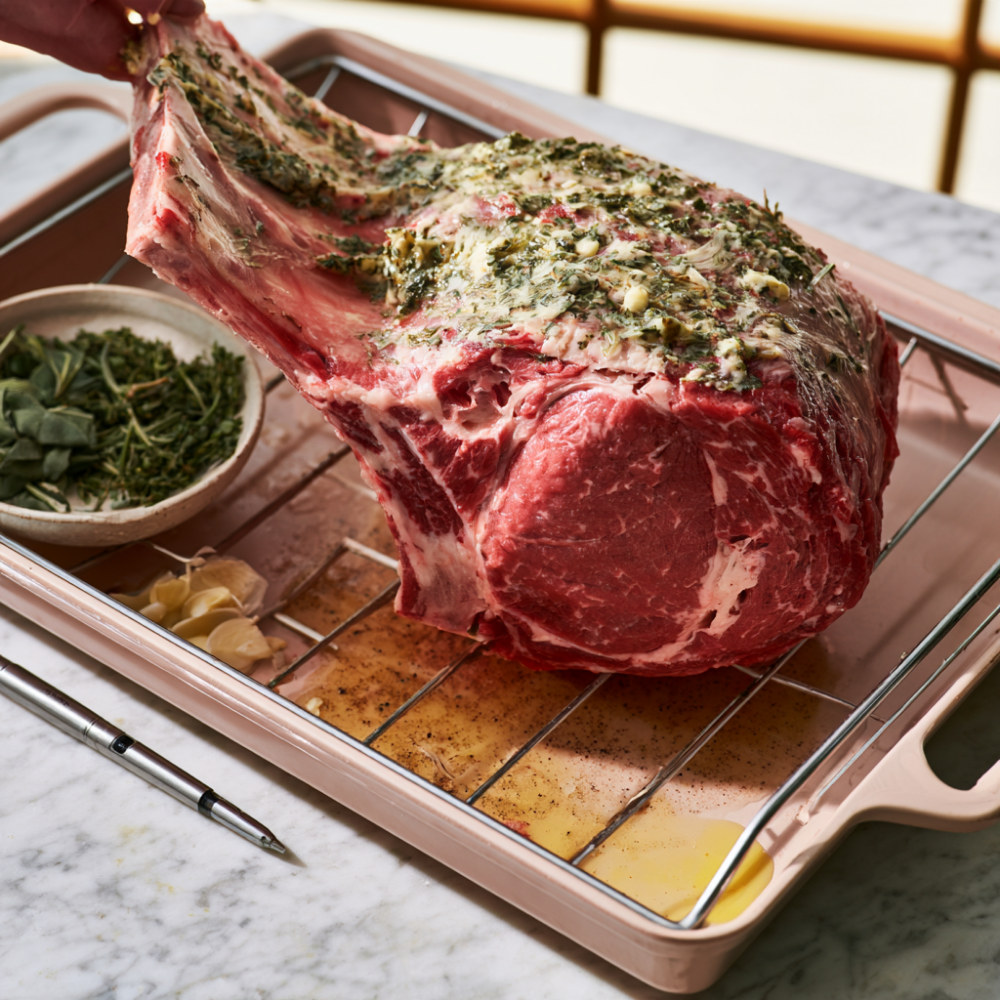
- Make the herb butter. Mash the softened butter with the rosemary, thyme, sage, grated garlic, Dijon, smoked paprika, salt, and pepper until it forms a uniform paste.
- Butter and stud the roast. Using your fingers, gently loosen the fat cap from the meat without removing it. Push half the herb butter into that pocket and spread it evenly. Rub the remaining butter over the top and sides of the roast. Cut small slits into the meat and insert the garlic slivers.
- Insert the probe thermometer. Place a probe thermometer into the thickest part of the roast, avoiding the bone. Set the alarm for 120°F for medium-rare.
- Roast low and slow. Place the roast bone-side down on a rack inside a roasting pan. Roast at 250°F until the probe reads 120°F, about 2 hours for a 6 lb roast. Start checking at 90 minutes. The exact time depends on your oven, the roast's shape, and how cold it was when it went in.
- Rest the roast. Remove the roast from the oven and transfer it to a cutting board. Tent it loosely with foil — do not wrap it tightly. Rest 30–45 minutes. The internal temperature will climb to about 128–132°F.
- Crank the oven. Raise the oven to 500°F and let it preheat fully, about 15 minutes.
- Blast for crust. Return the roast to the pan and roast at 500°F for 8–10 minutes, until the fat cap is deeply browned and crackling. Watch it closely — the difference between a crust and a burnt roast is about 90 seconds.
- Make the au jus. While the roast blasts, set the roasting pan on the stovetop over medium heat. Add the red wine and scrape up the browned bits. Simmer 3 minutes to reduce by half. Add the broth, rosemary, thyme, Worcestershire, and Dijon. Simmer 8 minutes. Off the heat, whisk in the cold butter until glossy. Strain and season.
- Carve and serve. Cut the bones away from the roast in one piece by slicing down along the bone line. Then slice the roast across the grain into ¾-inch thick portions. Sprinkle with flaky salt and serve with the au jus and horseradish.
Protein per Serving: 50 g.
Nutrition Note: A 6 lb bone-in roast yields about 4.5 lb edible meat, roughly 3.6 lb cooked, divided into 8 portions of about 7 oz each. At approximately 7 g of protein per ounce of cooked beef, that is about 50g per serving. Prime rib is a fatty cut — about 45g fat and 620 calories per serving. This is a holiday splurge, not a lean weeknight protein.
Tips for the Best Prime Rib Roast
- Dry brine 24 to 48 hours. This is the single biggest upgrade over the classic method. It seasons the meat through and dries the surface for a better crust.
- Leave the roast uncovered in the fridge. Air circulation is what dries the surface. A covered roast just gets wet.
- Do not leave it at room temperature for 6 hours. The classic recipe says 2 to 6 hours. Anything past 2 hours is a food safety risk, and the benefit is minimal.
- Use a probe thermometer with an alarm. Prime rib is too expensive to guess at. The alarm means you never have to open the oven.
- Cook at 250°F, not 325°F. Low heat is what gives you edge-to-edge pink instead of a thick gray band.
- Pull at 120°F for medium-rare. Carryover cooking brings it to 128–132°F during the rest. Pull at 125°F if your family prefers medium.
- Tent loosely, never tightly. Foil pressed against the crust steams it soft. A loose tent holds heat without ruining the surface.
- Rest 30 to 45 minutes minimum. Slicing early dumps the juices onto the board instead of keeping them in the meat.
- Blast at 500°F after resting, not before. This is the reverse sear. The crust forms last, so the interior never overcooks.
- Watch the blast minute by minute. Ten minutes is the target. Twelve minutes can scorch the fat cap.
- Cut the bones away in one piece. Slicing along the bone line gives you a clean roast to carve and bones for the jus.
- Slice across the grain and against the ribs. Cutting with the grain gives you chewy slices.
- Salt the slices, not the roast, at the table. The dry brine already seasoned the interior. Flaky salt on the cut face is the finish.
- Make the au jus from the drippings. This is where the flavor lives. A packet gravy wastes it.
- Buy bone-in if you can. The bones add flavor during roasting and insulate the bottom of the roast. Boneless works but cooks slightly faster.
Troubleshooting
- The roast is overcooked on the outside. The oven was too hot. Cook at 250°F and use a probe thermometer instead of a timer.
- The center is raw, and the outside is done. The roast went in cold. Temper it for a full 2 hours, no more and no less.
- The roast is gray all the way through. It was cooked past 140°F. Pull at 120°F and let carryover finish the job.
- The crust is pale. The 500°F blast was too short, or the roast was still wet. Dry brine uncovered and blast for the full 8–10 minutes.
- The crust is burnt. The blast ran too long, or the rack was too close to the top element. Move the rack to the middle and watch it.
- The herb butter slid off. The roast was cold when you applied it. Bring the roast toward room temperature and dry the surface first.
- The au jus tastes thin. It was not reduced enough. Simmer longer before adding the butter, and finish with the cold butter cubes off the heat.
- The au jus tastes bitter. The wine did not cook long enough. Simmer a full 3 minutes to burn off the alcohol.
- The roast is tough. It was carved with the grain, or it was cooked past medium. Slice across the grain and pull earlier next time.
- The slices fall apart. The roast was overcooked, or the knife was dull. Use a long slicing knife and let the roast rest fully.
- There is not enough jus. The roast was too lean, or the pan was too wide. Add an extra cup of broth and a tablespoon of butter.
- The leftovers taste dry. Prime rib is best the day it is made. Reheat gently and serve with extra jus, or use it cold in sandwiches.
Easy Variations
- Boneless Prime Rib Roast Oven. Use a 5 lb boneless ribeye roast. Reduce the roast time by about 15 minutes and start checking at 75 minutes.
- Smoked Prime Rib Roast. Smoke at 225°F to 120°F internal, then sear over high heat or under the broiler for 8 minutes.
- Prime Rib Crockpot Recipe. Not recommended for a whole roast — a slow cooker cannot build a crust. Use the slow cooker for leftover prime rib sandwiches instead.
- Garlic and Rosemary Only. Skip the sage and thyme, double the rosemary, and add 2 tbsp of prepared horseradish to the butter.
- Cajun Prime Rib. Swap the herb butter for 2 tbsp Cajun seasoning, ½ cup butter, and 1 tsp hot sauce.
- Coffee and Cocoa Crust. Add 1 tbsp espresso powder and 1 tbsp cocoa powder to the pepper rub for a steakhouse-style bark.
- Prime Rib with Red Wine Reduction. Reduce 2 cups red wine with 1 cup broth, shallots, and thyme to 1 cup for a thicker sauce.
- Herb Butter Prime Rib with Horseradish Cream. Whip ½ cup sour cream, ¼ cup prepared horseradish, 1 tbsp chives, and 1 tsp lemon juice.
- Prime Rib Au Jus Recipe — Sherry Version. Swap the red wine for dry sherry for a sweeter, nuttier jus.
- Christmas Prime Rib with Pomegranate. Scatter pomegranate arils over the platter for a seasonal garnish and a tart counterpoint to the beef.
- Leftover Prime Rib Recipes — Sandwiches. Pile thin slices on crusty rolls with horseradish cream, arugula, and a dip of au jus.
- Leftover Prime Rib Recipes — Hash. Dice the meat and pan-fry with potatoes, onions, and thyme until the edges crisp.
Storage and Food Safety
Refrigerator: Store sliced prime rib in an airtight container for up to 4 days. Keep the au jus separate. Reheat gently at 300°F covered with a splash of jus, or serve cold in sandwiches.
Freezer: Freeze sliced prime rib for up to 3 months, wrapped tightly and then bagged. Thaw overnight in the refrigerator. Reheat gently — high heat will dry it out. The au jus freezes well for 3 months.
Make Ahead: Dry brine 24–48 hours ahead. You can make the herb butter 3 days ahead and refrigerate it. Cook the roast the day you serve it.
Food Safety: Do not leave the roast at room temperature for more than 2 hours — the classic “2 to 6 hours” instruction is not food safe. Beef should reach a minimum internal temperature of 145°F for USDA safety, though whole-muscle roasts cooked to 130°F are widely considered safe when the surface has been seared. Cool leftovers within 2 hours and refrigerate promptly. Reheat leftovers to 165°F.
Frequently Asked Questions
How long do I cook a prime rib roast in the oven? About 20 minutes per pound at 250°F to reach 120°F, then 8–10 minutes at 500°F. For a 6 lb roast, plan on about 2 hours at low heat.
What temperature should prime rib be pulled at? 120°F for medium-rare, 125°F for medium, 130°F for medium-well. Carryover cooking adds 5–10°F during the rest.
Should I use the 500°F and oven-off method? It works in a well-insulated oven, but it is less reliable and produces a wider gray band. The reverse sear gives better, more consistent results.
Do I really need to dry brine for 24 hours? You can cook it right away, but a 24-hour dry brine noticeably improves both seasoning and crust. Even 12 hours helps.
Can I leave the roast out for 6 hours to come to room temperature? No. Two hours maximum. Anything longer is a food safety risk, and the cooking benefit is small.
Bone-in or boneless? Bone-in adds flavor and insulates the bottom of the roast. Boneless is easier to carve and cooks slightly faster.
How much prime rib per person? About ¾ to 1 lb per person with the bone in, or ½ lb boneless. A 6 lb bone-in roast serves 6 to 8.
Why is my prime rib gray? It was cooked past 140°F, or the oven was too hot. Cook at 250°F and pull at 120°F.
How do I get a crust on prime rib? Dry brine uncovered, dry the surface before roasting, and blast at 500°F for 8–10 minutes at the end.
Can I make au jus without wine? Yes. Use 3 cups of beef broth, 1 tbsp Worcestershire, and 1 tsp red wine vinegar for acidity.
Should I cover the roast while it rests? Tent it loosely. Tight foil steams the crust and softens it.
How do I carve a bone-in prime rib? Cut down along the bone line to remove the bones in one piece, then slice the roast across the grain into ¾-inch portions.
Can I use a convection oven? Yes, but reduce the temperature by 25°F and start checking earlier. Convection ovens cook faster.
What do I serve with prime rib? Mashed potatoes, Yorkshire pudding, roasted Brussels sprouts, creamed spinach, green beans, and horseradish cream.
How long do leftovers last? Up to 4 days in the refrigerator or 3 months in the freezer.
More Holiday Recipes You’ll Love
- Creamy Butternut Squash & Turkey Sausage Pasta Bake
- 7 Easy & Juicy Thanksgiving Turkey Recipes for Every Kind of Cook
- Fall Harvest Pasta Salad — 30g protein, make-ahead lunch prep.
Conclusion
Prime rib is the dish that carries the holiday. It is the one everybody remembers, the one that gets photographed, and the one that determines whether you spend the rest of the meal quietly proud or quietly apologizing. That is a lot of pressure for a roast with four steps.
Which is exactly why the technique matters. Not because prime rib is hard, but because the margin for error is small and the audience is large.
Dry brine it for a day. Dry the surface. Push herb butter under the fat cap and stud the meat with garlic. Cook at 250°F to 120°F and watch the probe instead of the clock. Rest it loosely. Blast it at 500°F for ten minutes. Make the au jus from the drippings with red wine and fresh herbs.
That gets you a roast with edge-to-edge pink, a crust that crackles, and a sauce that tastes like the meat it came from.
Fifty grams of protein per serving. Christmas dinner handled.
Do it once, and you will never go back to the oven-off method.