
Fall days call for a different kind of salad. Not the cold, crisp kind that belongs to July — the kind that comes out of a hot oven, with vegetables still warm from roasting, tossed with a hearty grain that actually fills you up.
That is what this farro salad is built for.
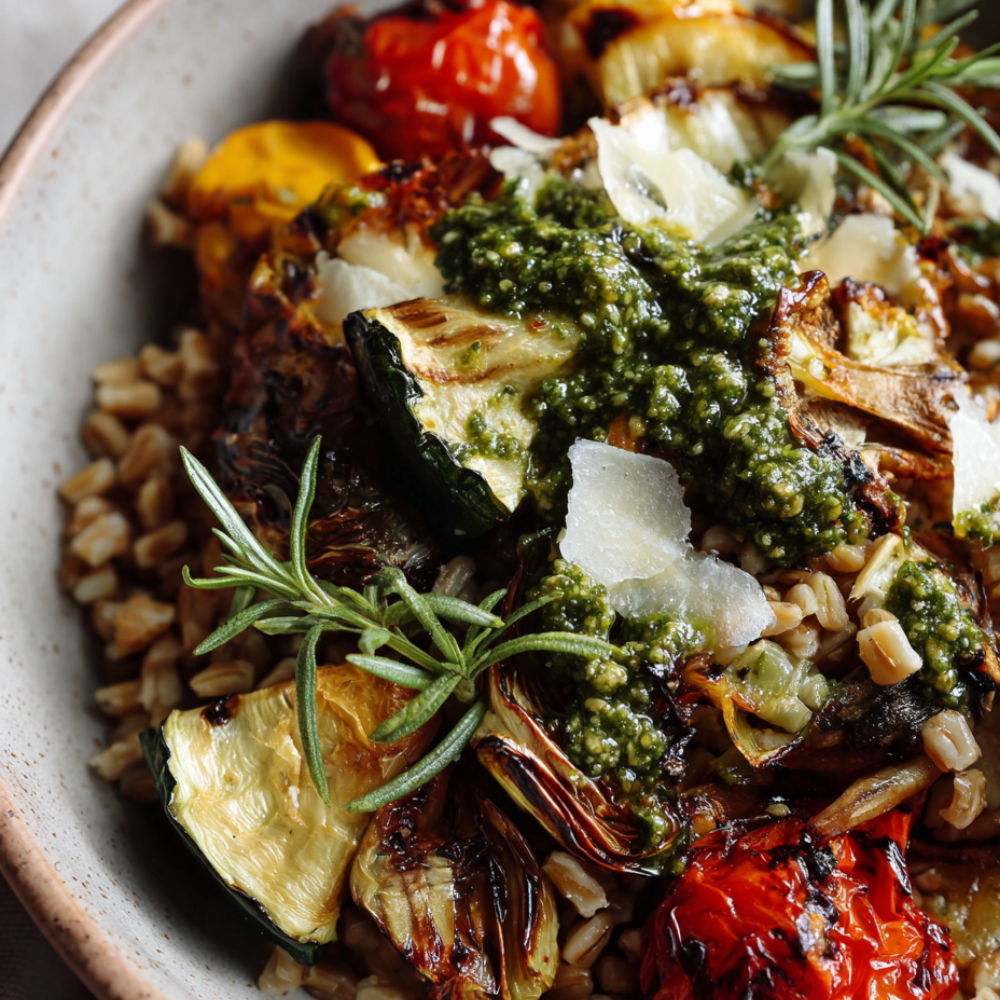
Roasted zucchini, blistered cherry tomatoes, red and yellow bell peppers, and eggplant, all deep golden at the edges and still glistening with olive oil and oregano.
Tossed with chewy farro, whole mozzarella pearls, and a bright pesto dressing thinned with lemon and good olive oil.
Finished with shaved Parmesan, toasted pine nuts, and torn fresh basil.
It is the kind of salad that eats like a meal.
Farro has a chew and substance that quinoa and rice don’t — it holds its shape after dressing, absorbs flavor instead of sitting in it, and gives a bowl of vegetables the kind of weight that makes it feel like dinner.
The mozzarella brings creaminess, the Parmesan brings salt, and the pesto’s pine nuts add a buttery crunch.
And it holds. Unlike a lettuce salad, nothing wilts.
Roasted vegetables and farro both improve as they sit in the dressing, so you can make this on Sunday and eat it through Wednesday, or dress it an hour before a fall dinner party and set it on the table next to the roast.
Twenty-two grams of protein per serving, and none of it is forced. It comes naturally from the farro, the mozzarella, and the pine nuts and Parmesan in the dressing — the kind of quiet protein that makes a grain salad genuinely satisfying.
Why This Recipe Works
- Roasting the vegetables at high heat concentrates their sweetness. Zucchini, tomatoes, peppers, and eggplant all release water and sugars as they roast, and those sugars caramelize at the edges. That is the depth of flavor raw vegetables cannot deliver.
- Salting the eggplant first is what keeps it from turning greasy. Eggplant is a sponge and absorbs oil. A 20-minute salt, a rinse, and a pat-dry removes excess moisture and lets it brown instead of soak.
- Cherry tomatoes are the right tomato for roasting. They hold their shape, blister at the edges, and turn jammy instead of dissolving into sauce.
- Roasting on a single layer matters more than it sounds. Crowded vegetables steam and turn soft. Spread out with space between them, they brown at the edges and stay firm in the middle.
- Cooking farro in broth instead of water seasons the grain all the way through. Farro is dense and absorbs whatever it cooks in. Broth gives every grain a savory backbone.
- Cooling the farro completely before dressing is what keeps the salad from turning mushy. Warm farro steams and softens. Cooled farro holds its chew and absorbs the pesto without breaking down.
- Dressing the farro while it is slightly warm is what makes it taste finished. A little residual heat helps the grain absorb the pesto. It is the one moment where slight warmth works in your favor.
- Mozzarella pearls go in whole. They stay intact through folding and give you soft, creamy bites instead of shreds of cheese scattered everywhere.
- Thin pesto with lemon juice and olive oil to make a dressing instead of a sauce. Straight pesto is too thick to coat a salad. Thinned, it clings to the farro and the vegetables without weighing them down.
- Fresh basil and shaved Parmesan go on at the end, not into the bowl. Both are fragile. Added at serving, they stay bright and sharp instead of wilting into the salad.
- The protein is not forced. Farro, mozzarella, and the pine nuts and Parmesan in the dressing deliver about 22g per serving naturally.
Fall days call for a different kind of salad. Not the cold, crisp kind that belongs to July — the kind that comes out of a hot oven, with vegetables still warm from roasting, tossed with a hearty grain that actually fills you up.
That is what this farro salad is built for.
Roasted zucchini, blistered cherry tomatoes, red and yellow bell peppers, and eggplant, all deep golden at the edges and still glistening with olive oil and oregano.
Tossed with chewy farro, whole mozzarella pearls, and a bright pesto dressing thinned with lemon and good olive oil. Finished with shaved Parmesan, toasted pine nuts, and torn fresh basil.
It is the kind of salad that eats like a meal. Farro has a chew and substance that quinoa and rice don’t — it holds its shape after dressing, absorbs flavor instead of sitting in it, and gives a bowl of vegetables the kind of weight that makes it feel like dinner.
The mozzarella brings creaminess, the Parmesan brings salt, and the pesto’s pine nuts add a buttery crunch.
And it holds. Unlike a lettuce salad, nothing wilts. Roasted vegetables and farro both improve as they sit in the dressing, so you can make this on Sunday and eat it through Wednesday, or dress it an hour before a fall dinner party and set it on the table next to the roast.
Twenty-two grams of protein per serving, and none of it is forced. It comes naturally from the farro, the mozzarella, and the pine nuts and Parmesan in the dressing — the kind of quiet protein that makes a grain salad genuinely satisfying.
Why This Recipe Works
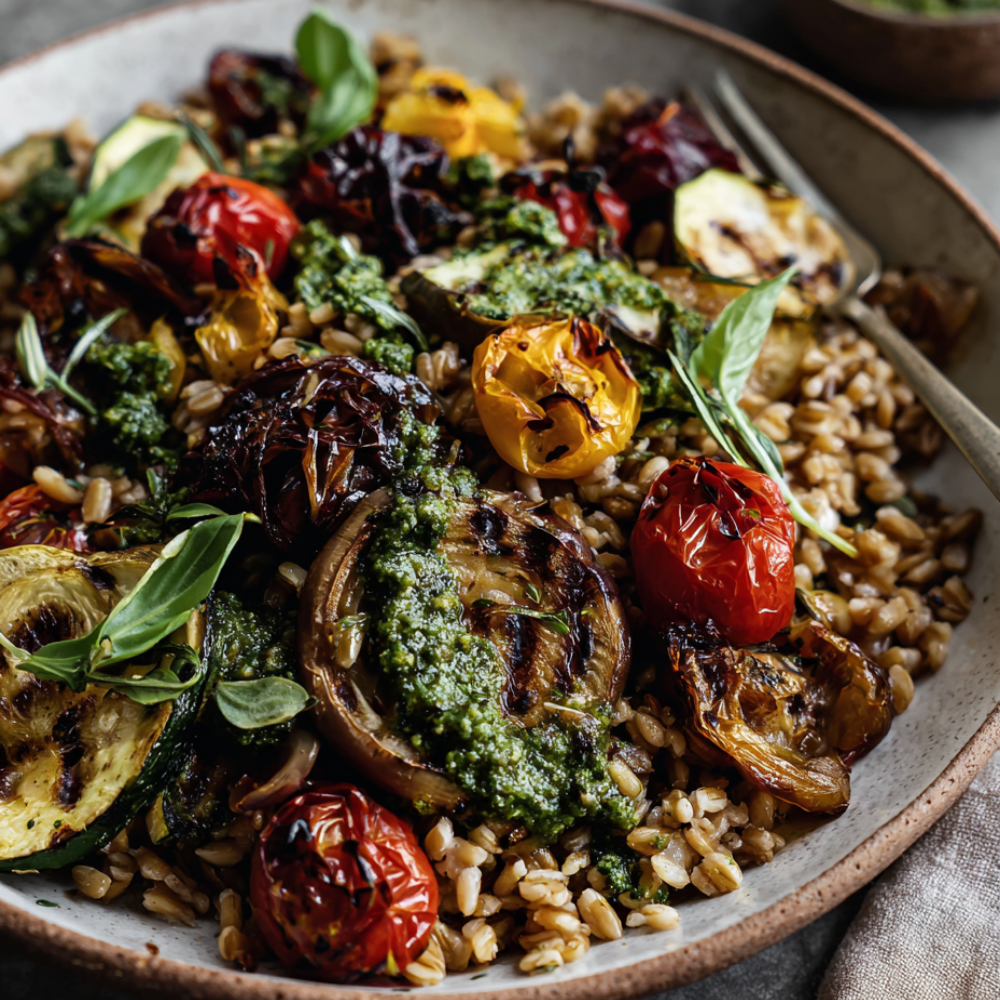
- Roasting the vegetables at high heat concentrates their sweetness. Zucchini, tomatoes, peppers, and eggplant all release water and sugars as they roast, and those sugars caramelize at the edges. That is the depth of flavor raw vegetables cannot deliver.
- Salting the eggplant first is what keeps it from turning greasy. Eggplant is a sponge and absorbs oil. A 20-minute salt, a rinse, and a pat-dry removes excess moisture and lets it brown instead of soak.
- Cherry tomatoes are the right tomato for roasting. They hold their shape, blister at the edges, and turn jammy instead of dissolving into sauce.
- Roasting on a single layer matters more than it sounds. Crowded vegetables steam and turn soft. Spread out with space between them, they brown at the edges and stay firm in the middle.
- Cooking farro in broth instead of water seasons the grain all the way through. Farro is dense and absorbs whatever it cooks in. Broth gives every grain a savory backbone.
- Cooling the farro completely before dressing is what keeps the salad from turning mushy. Warm farro steams and softens. Cooled farro holds its chew and absorbs the pesto without breaking down.
- Dressing the farro while it is slightly warm is what makes it taste finished. A little residual heat helps the grain absorb the pesto. It is the one moment where slight warmth works in your favor.
- Mozzarella pearls go in whole. They stay intact through folding and give you soft, creamy bites instead of shreds of cheese scattered everywhere.
- Thin pesto with lemon juice and olive oil to make a dressing instead of a sauce. Straight pesto is too thick to coat a salad. Thinned, it clings to the farro and the vegetables without weighing them down.
- Fresh basil and shaved Parmesan go on at the end, not into the bowl. Both are fragile. Added at serving, they stay bright and sharp instead of wilting into the salad.
- The protein is not forced. Farro, mozzarella, and the pine nuts and Parmesan in the dressing deliver about 22g per serving naturally.
Italian Farro Salad with Roasted Vegetables and Pesto
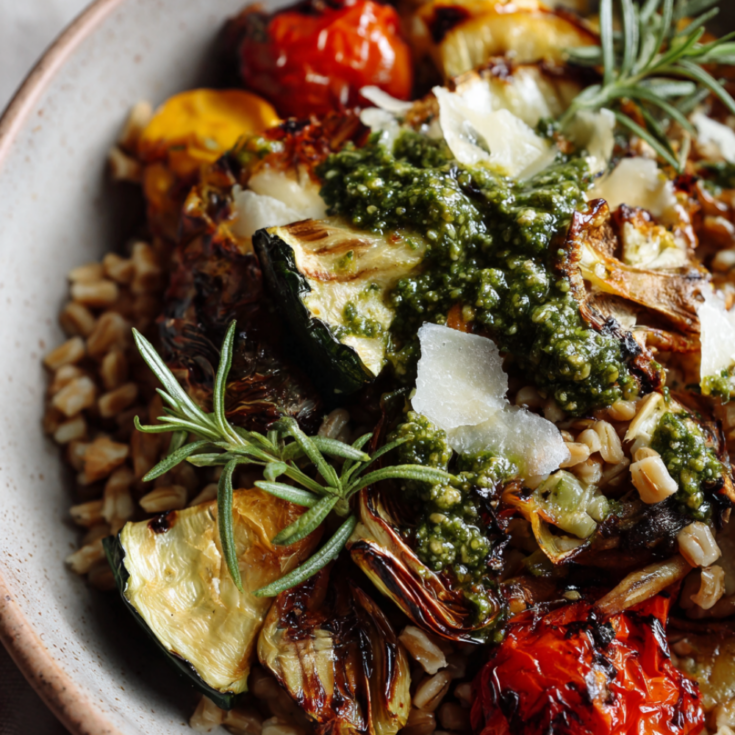
Roasted zucchini, cherry tomatoes, bell peppers, and eggplant tossed with chewy farro, mozzarella pearls, and a bright pesto dressing. Twenty-two grams of protein per serving.
Ingredients
For the Farro
- 2 cups dry farro, rinsed
- 4 cups low-sodium vegetable or chicken broth
- 1 tsp kosher salt
For the Roasted Vegetables
- 1 medium eggplant, cut into 1-inch cubes
- 2 medium zucchini, cut into ½-inch half-moons
- 1 pint cherry tomatoes, left whole
- 1 red bell pepper, cut into 1-inch pieces
- 1 yellow bell pepper, cut into 1-inch pieces
- 1 small red onion, cut into wedges
- 4 tbsp olive oil, divided
- 2 tsp kosher salt, divided
- ½ tsp black pepper
- 1 tsp dried oregano
- ½ tsp red pepper flakes
For the Pesto Dressing
- ½ cup basil pesto
- 3 tbsp olive oil
- 2 tbsp fresh lemon juice
- 1 tbsp white balsamic vinegar or red wine vinegar
- 1 tsp Dijon mustard
- 1 clove garlic, grated
- ¼ tsp kosher salt
- ¼ tsp black pepper
For the Salad
- 1½ cups mozzarella pearls, drained (optional)
- ½ cup shaved Parmesan (optional)
- ½ cup fresh basil leaves, torn
- ¼ cup toasted pine nuts
- Flaky salt and black pepper to taste
Notes
Protein per Serving: 22 g.
Nutrition Note: Protein calculated from 2 cups dry farro yielding about 6 cups cooked (≈42g protein), 1½ cups mozzarella pearls (≈48g), ½ cup pesto (≈10g), ½ cup shaved Parmesan (≈20g), ¼ cup toasted pine nuts (≈5g), and roasted vegetables (≈10g), divided by 6 servings — about 22g per serving. About 510 calories per serving. Sodium varies with the pesto and cheese — use a low-sodium pesto if you are watching it.
Tips for the Best Farro Salad
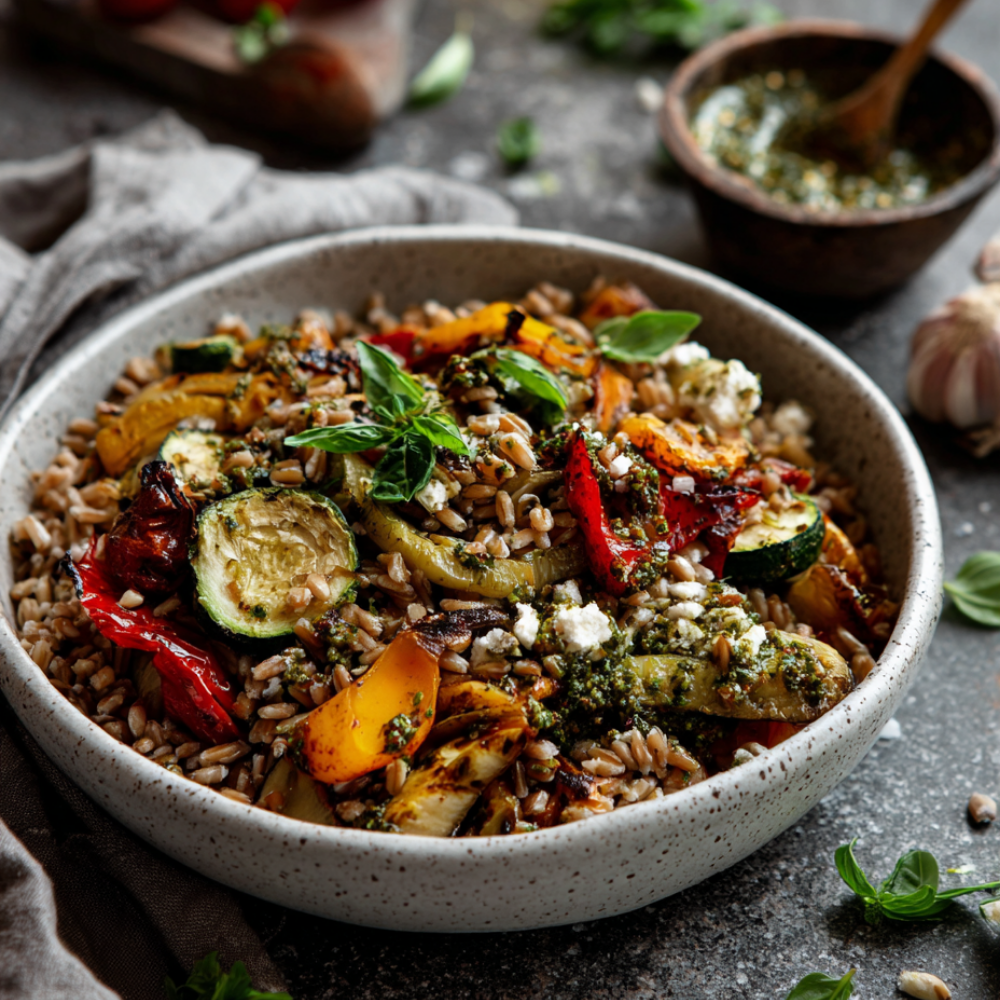
- Salt the eggplant before it goes on the pan. Twenty minutes draws out moisture and keeps it from soaking up oil. Pat dry before roasting.
- Cook the farro in broth, not water. Farro absorbs whatever it cooks in. Broth gives every grain a savory backbone and makes the salad taste finished before the dressing even goes on.
- Cool the farro completely before you dress the whole bowl. A little residual warmth is fine when you add the first half of the dressing, but fully warm farro steams and turns soft.
- Roast the vegetables in a single layer. Crowding steams them, and they turn soft instead of caramelizing at the edges. Use two pans if you need to.
- Keep the cherry tomatoes whole. They blister and turn jammy as they roast. Halved tomatoes lose their juice on the pan.
- Thin the pesto with lemon juice and oil. Straight pesto is too thick to coat a salad. Thinned, it becomes a dressing that clings without weighing things down.
- Add the mozzarella pearls last and fold gently. Stirring hard breaks them apart, and the salad turns cloudy.
- Rest the salad 10 minutes before serving, or a day before eating. Farro absorbs dressing, so both the flavors and the texture improve as it sits.
Troubleshooting
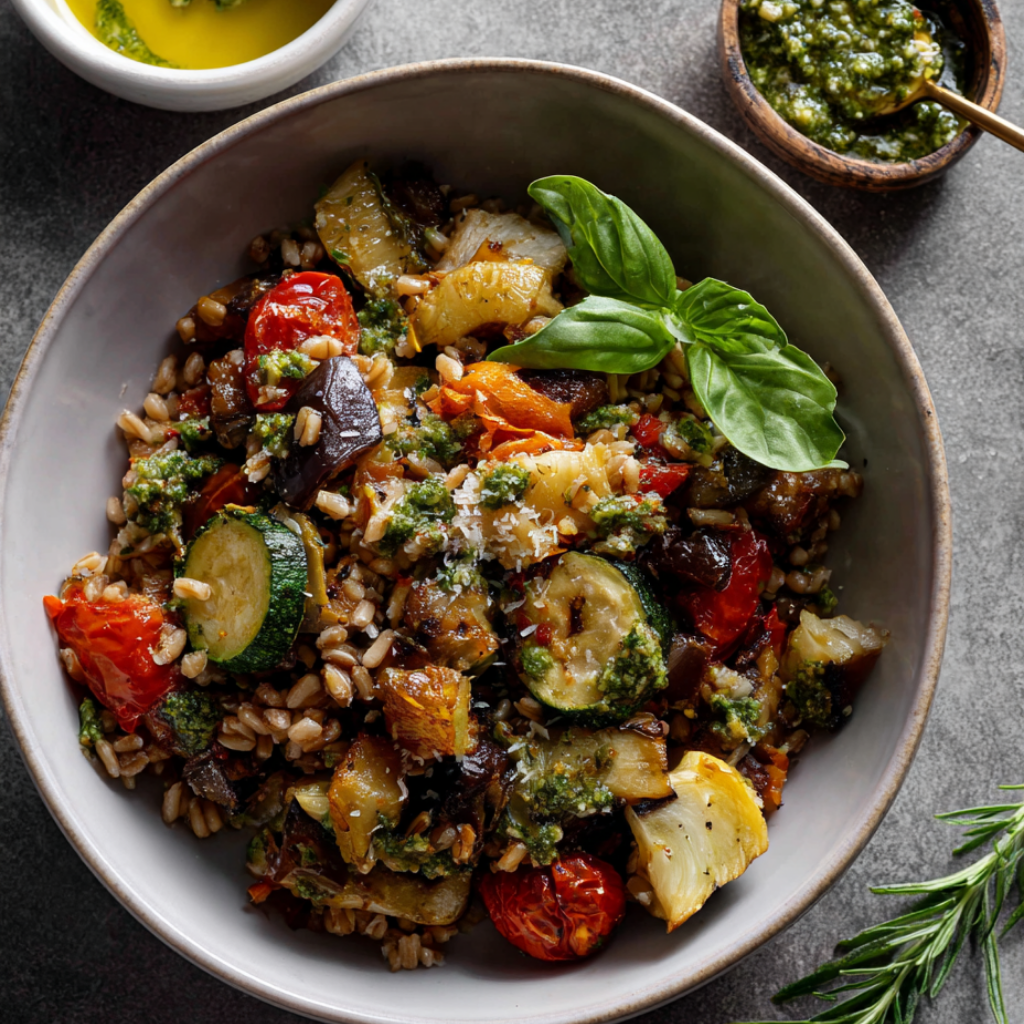
- The eggplant turned greasy. You didn’t salt it first, or you added too much oil to the pan. Salt the eggplant for 20 minutes, pat it dry, and use no more than 3 tbsp of oil for the entire pan.
- The eggplant turned mushy. It was cut too small or roasted too long. Cut into 1-inch cubes and start checking at 25 minutes.
- The farro turned out mushy. It was overcooked, or it sat in the pot with excess liquid. Drain immediately and spread it on a sheet pan to cool.
- The farro is still chewy after 30 minutes. Some brands of farro take longer, especially pearled versus whole grain. Add ½ cup more broth and simmer 10 more minutes.
- The salad is dry the next day. Farro absorbed the dressing. Toss with 1 tbsp of pesto thinned with 1 tbsp of olive oil and a squeeze of lemon before serving.
- The vegetables turned soft. They were crowded on the pan or roasted too long. Use two pans and pull them at 30 minutes if the edges are browned.
- The salad tastes flat. It needs salt, acid, or both. Add a squeeze of lemon and ¼ tsp flaky salt and taste again.
- The mozzarella broke apart, and the salad looks cloudy. The pearls were stirred too hard. Fold gently with a spatula, or add them after the rest and toss once.
Easy Variations
- Farro Salad with Grilled Chicken. Add 2 cups of sliced grilled chicken to the bowl with the mozzarella. Protein rises to about 36g per serving.
- Greek Farro Salad. Swap the mozzarella for 1 cup of crumbled feta, add ½ cup of Kalamata olives, and use red wine vinegar in the dressing.
- Mediterranean Farro Salad. Add 1 cup chopped cucumber, ½ cup roasted red peppers, and ¼ cup chopped sun-dried tomatoes.
- Summer Farro Salad. Skip the eggplant and swap the roasted vegetables for raw cherry tomatoes, cucumber, and corn. Use a lemon vinaigrette instead of pesto.
- Mushroom Farro Salad. Replace the eggplant and zucchini with 1 lb of quartered cremini mushrooms, roasted at 425°F for 25 minutes until deeply browned.
Storage and Food Safety
Refrigerator: Store in an airtight container for up to 4 days. Farro salads hold better than lettuce salads because the grain absorbs the dressing instead of wilting. Bring to room temperature and toss with a splash of dressing and lemon before serving.
Freezer: Not recommended. Roasted vegetables and mozzarella both lose texture after thawing, and the pesto separates.
Make Ahead: Cook the farro up to 4 days ahead and refrigerate. You can roast the vegetables up to 3 days ahead. The dressing can be made up to a week ahead. Assemble the full salad up to 24 hours before serving.
Food Safety: Cool cooked farro within 2 hours and refrigerate promptly. Do not leave the salad at room temperature for more than 2 hours. If reheating, heat leftovers to 165°F, though the salad is best cold or at room temperature.
Frequently Asked Questions
How much protein is in this farro salad? About 22g per serving from the farro, mozzarella, pine nuts, and Parmesan in the pesto. Adding 2 cups of shredded chicken brings it to about 36g.
What is farro and where do I find it? Farro is an ancient wheat grain with a nutty flavor and a chewy texture. Look for it near the rice and grains in the grocery store, or order it online. Pearled farro cooks fastest.
What is the difference between pearled and whole grain farro? Pearled farro has had the outer bran layer removed, so it cooks in 20 to 25 minutes. Whole grain farro takes 35 to 40 minutes and has a chewier texture. Both work in this recipe.
Can I use a different grain? Yes. Wheat berries, barley, and brown rice all work. Adjust the cooking time to the grain.
Can I make this gluten-free? Not as written — farro contains gluten. Substitute 2 cups of cooked quinoa, wild rice, or buckwheat groats.
Do I have to salt the eggplant? Yes, it is the single step that keeps the eggplant from turning greasy. Twenty minutes, then pat dry.
Can I use store-bought pesto? Yes. A good jarred basil pesto works well. Taste it first and adjust the lemon and salt accordingly.
Do I need to toast the pine nuts? Yes, if you have time. A dry skillet over medium heat for 3 minutes transforms them from soft and slightly bitter to buttery and fragrant.
Can I serve this warm? Yes. It is excellent warm, straight from the pan, with the farro still slightly warm and the mozzarella beginning to soften. It is best eaten the same day.
Can I make this vegan? Yes. Use a vegan pesto without Parmesan and skip the mozzarella and Parmesan garnish. Protein drops to about 12g per serving.
How far ahead can I make it? Up to 24 hours ahead. It holds beautifully and tastes better after a few hours in the refrigerator.
What do I serve with it? Grilled chicken, roasted salmon, a piece of seared steak, or a simple bowl of soup.
How long do leftovers last? Up to 4 days in the refrigerator.
Can I double the recipe? Yes. Use a larger bowl and a second sheet pan for the vegetables.
Do I need to rinse the farro? Yes. Rinsing removes surface starch and keeps the salad from turning sticky.
More High-Protein Salad Recipes You’ll Love
- Kale Quinoa Salad — 20g protein, cranberry walnut, maple vinaigrette.
- Fall Harvest Pasta Salad — 30g protein, make-ahead lunch prep.
- Pumpkin Salad with Quinoa, Feta & Pomegranate — 16g Protein, Turmeric Roasted
Conclusion
Fall salads should look and taste like fall.
Not a bowl of cold greens and raw vegetables, but something that came out of a hot oven — vegetables caramelized at the edges, a grain with real chew, and a dressing that ties it all together.
This farro salad is that. Roasted zucchini, blistered tomatoes, red and yellow peppers, and deeply golden eggplant. Chewy farro, whole mozzarella pearls, and a bright pesto dressing thinned with lemon. Top with shaved Parmesan, toasted pine nuts, and torn basil.
These three things make it work. Salt the eggplant before it goes on the pan so it browns instead of soaking up oil. Cook the farro in broth so every grain is seasoned. And dress the farro while it is still slightly warm so it absorbs the pesto instead of sitting in it.
Twenty-two grams of protein per serving, and none of it is forced. It comes from the farro and the cheese, the way a good grain salad should.
After four days in the refrigerator, it tastes even better on day two. Make it once this fall, and it earns a permanent spot in the rotation.