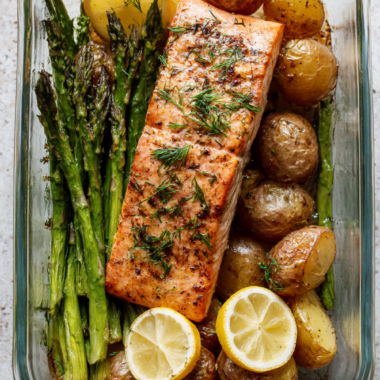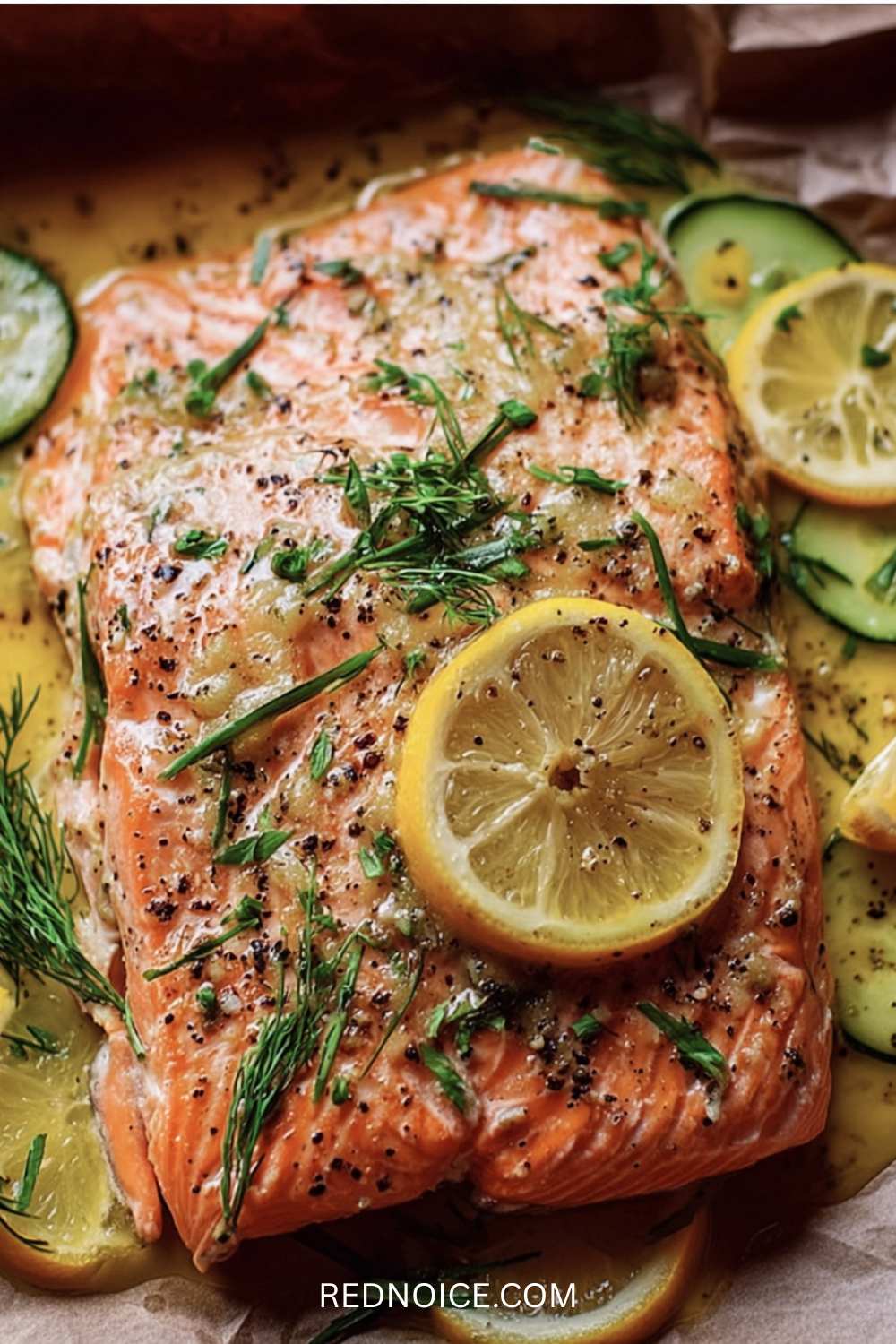

Baked salmon is the dinner I make when I want something that tastes like a restaurant plate but takes less than half an hour.
The first version I made came out dry and chalky — I’d left it in the oven until it “looked done,” which meant it had cooked to 155°F and lost all its moisture. The fix was a thermometer.
Pull the salmon at 135°F and let it rest, and carry-over cooking brings it to 145°F while the fish stays tender and flaky.
The technique is mostly about two things: dry the fish and don’t overcook it.
Patting the salmon completely dry with paper towels before seasoning is what makes the salt, garlic powder, and lemon zest stick to the surface instead of sliding off.
And the 135°F pull temperature is the difference between a fillet that flakes into soft, juicy pieces and one that crumbles into dry flakes.
The lemon and dill are doing the flavor work. Fresh lemon zest goes into the seasoning, thin lemon slices go on top of the fillets, and fresh dill gets divided between the seasoning and the garnish.
The lemon slices leave the edges of the salmon exposed so the fish bakes evenly — if you cover the whole fillet with lemon, it steams instead of roasts.
The whole thing comes together in about 5 minutes of prep and 12 to 15 minutes in the oven, and it serves two with 34 grams of protein per serving.
It’s a high-protein dinner that tastes like a Mediterranean restaurant plate, made in your own kitchen on a Tuesday.
Why This Recipe Works

Baked salmon goes wrong in three specific ways: dry fish, bland flavor, and uneven cooking. Here’s how this version solves each one.
1. Pull at 135°F and Let Carry-Over Cooking Finish It
Salmon is safe at 145°F, but it’s best at 135°F to 140°F after resting. Pulling the fish at 135°F and letting it rest 2 to 3 minutes means carry-over cooking brings it up to 145°F while the flesh stays tender and flaky. If you wait until the fish reads 145°F in the oven, it’s already overcooked and the carry-over takes it to 155°F or higher — dry and chalky. The thermometer is the whole technique.
2. Dry the Fish Thoroughly Before Seasoning
Wet salmon steams instead of roasts, and the seasoning slides off the surface instead of sticking. Patting the fillets completely dry with paper towels before the oil and seasoning go on is what gives you a seasoned crust instead of a wet, pale fillet.
3. Top With Lemon Slices, But Leave the Edges Exposed
The lemon slices on top add flavor and look beautiful, but if they cover the entire fillet they block the heat and steam the fish. Arranging 2 to 3 thin slices across the top of each fillet, leaving the edges exposed, lets the salmon bake evenly while still getting the lemon flavor.
Ingredients That Matter
Two salmon fillets, 6 oz each. Center-cut fillets of even thickness cook evenly. Skin-on is the recommended choice — the skin protects the flesh during baking and releases easily after cooking. If using skinless, reduce the bake time by 1 to 2 minutes and watch closely.
Extra-virgin olive oil. One tablespoon. The oil carries the seasoning and helps the lemon zest and dill stick to the fish.
Fine sea salt and freshly cracked black pepper. Half a teaspoon of salt and a quarter teaspoon of pepper. The salt level depends on the thickness of the fillets — taste the first bite and add a pinch more if needed.
Garlic powder. A quarter teaspoon. Garlic powder works better than fresh garlic here because fresh garlic burns at 400°F.
Fresh lemon zest. From half a lemon. The zest is where the lemon oil lives and it holds up to baking better than the juice.
One lemon, thinly sliced into rounds. Plus extra lemon wedges for serving. The slices go on top of the fillets; the wedges go on the plate.
Fresh dill. Two tablespoons, finely chopped and divided. Half goes into the seasoning, half goes on as a garnish after baking. Fresh dill is essential — dried dill loses its flavor.
Do not use lemon juice in the seasoning. Lemon juice before baking makes the salmon taste sour and can break down the surface of the fish. The zest and the slices carry the lemon flavor.
How to Make Baked Salmon With Lemon & Herbs
(See the recipe card below — the steps are identical and the card is the single source of truth.)
Tips and Troubleshooting
The salmon came out dry. It cooked past 135°F, or it stayed in the oven too long. Pull it at 135°F and let carry-over cooking bring it to 145°F during the rest. If you don’t have a thermometer, pull it when the thickest part flakes easily with a fork but is still slightly translucent in the center.
The salmon came out bland. It wasn’t seasoned enough, or the lemon zest was skipped. Season generously and use the full amount of zest — it’s what carries the lemon flavor into the fish.
The lemon slices stuck to the fish. They baked on too long, or the fish wasn’t oiled under them. Drizzle the fish with olive oil before adding the lemon slices, and use thin slices (about ⅛ inch) so they soften into the fish instead of sticking.
The dill burned. It went on before baking instead of after. Dill goes on in two stages — half in the seasoning, half after baking as a garnish. The second half is what gives the dish its fresh dill flavor.
The salmon stuck to the parchment paper. It wasn’t oiled, or the fish sat in its own juices. Drizzle the fillets with olive oil before baking, and don’t let them sit in the pan after they come out of the oven.
The salmon is undercooked in the center. The fillets were too thick, or the oven ran cool. Add 1 to 2 minutes and check again at 135°F.
The skin stuck to the pan. The fish went in skin-side up. Skin-side down on the parchment is correct — the skin protects the flesh and releases easily after baking.
The salmon tastes fishy. It wasn’t fresh, or it sat too long before cooking. Use fresh salmon, cook it within a day or two of buying, and pat it dry before seasoning.
Substitutions and Swaps
Atlantic salmon → wild-caught sockeye or coho. Sockeye is leaner and cooks slightly faster — check at 10 minutes. Coho is similar to Atlantic in fat content.
Fresh dill → fresh parsley or tarragon. Parsley is milder; tarragon is more anise-forward. Same quantity.
Lemon → lime or orange. Lime is sharper; orange is sweeter. Same quantity.
Skin-on → skinless. Same quantity, but reduce the bake time by 1 to 2 minutes and watch closely — skinless fillets cook faster.
For a broiled top: switch the oven to broil for the last 1 to 2 minutes of baking, watching closely, for a slightly browned and crisped surface.
For a Mediterranean bowl: serve the salmon over quinoa with sliced cucumber, cherry tomatoes, kalamata olives, and a drizzle of the pan juices.
For a meal prep version: bake the salmon, cool it, and store it in a glass container for up to 3 days. Serve chilled and flaked over salads, or reheat gently in a covered skillet over low heat with a tablespoon of water.
Storage and Reheat
Refrigerate leftover baked salmon in a glass airtight container for up to 3 days.
Reheat gently in a covered skillet over low heat with 1 tablespoon of water or broth for 3 to 4 minutes, or serve chilled and flaked over salads. Avoid high-heat microwaving — it dries out the fish.
Food safety: store leftovers within 2 hours of cooking. Reheat to 145°F before serving. Discard anything left at room temperature longer than 2 hours.
Baked Salmon With Lemon & Herbs
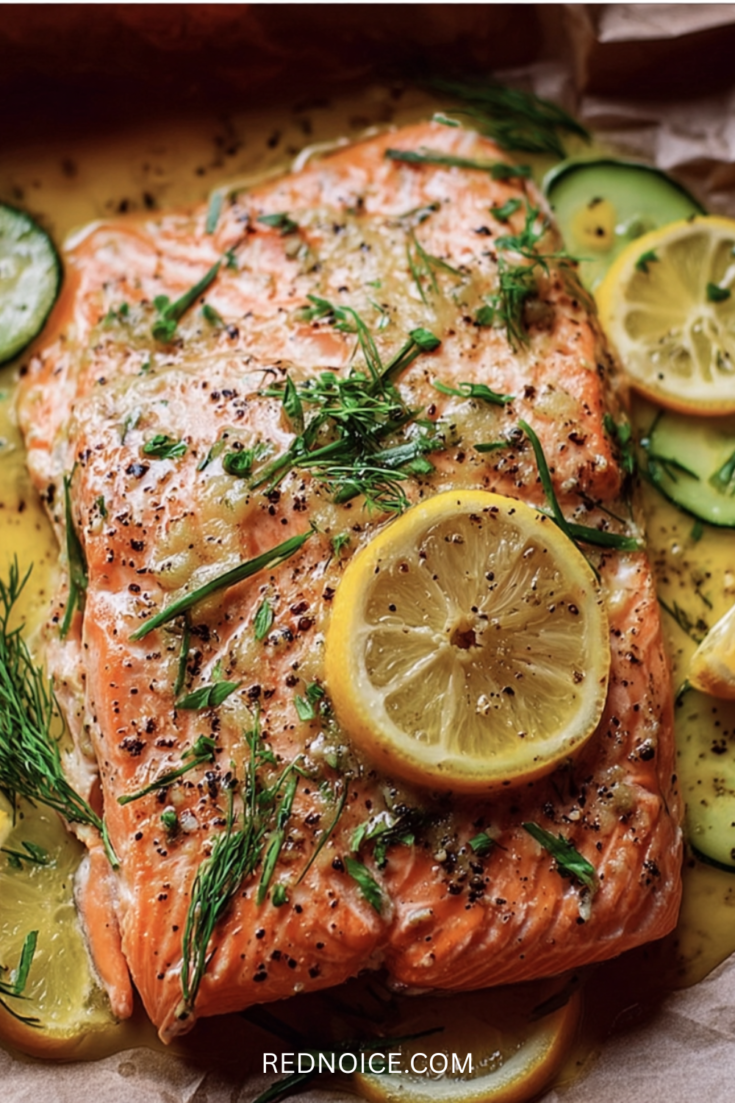
Tender, flaky salmon fillets baked with fresh lemon zest, garlic, extra-virgin olive oil, and dill — 34g of protein per serving in just 20 minutes.
Ingredients
Salmon and Seasoning Base
- 2 salmon fillets (6 oz each), skin-on or skinless (center-cut fillets of even thickness preferred)
- 1 tablespoon extra-virgin olive oil
- ½ teaspoon fine sea salt
- ¼ teaspoon freshly cracked black pepper
- ¼ teaspoon garlic powder
- ½ lemon, zested
- Aromatics and Finish
- 1 lemon, thinly sliced into rounds (plus extra lemon wedges for serving)
- 2 tablespoons fresh dill, finely chopped (divided)
Instructions
- Prep and Dry the Salmon: Preheat the oven to 400°F. Line a baking sheet with parchment paper. Pat the salmon fillets completely dry on all sides with paper towels to ensure the seasoning adheres.
- Season the Fillets: Place the salmon fillets skin-side down on the prepared baking sheet. Drizzle evenly with the extra-virgin olive oil. Season with the sea salt, black pepper, garlic powder, fresh lemon zest, and half (1 tablespoon) of the chopped dill.
- Top With Lemon Slices: Arrange 2 to 3 thin lemon slices across the top of each fillet, leaving the edges exposed so the fish bakes evenly.
- Bake to Tender Flake: Bake 12 to 15 minutes, depending on thickness. The salmon is ready when opaque on the outside and gently flakes with a fork at the thickest part. Pull at 135°F — carry-over cooking will bring it to 145°F during the rest.
- Rest and Serve: Remove from the oven and let rest 2 to 3 minutes. Sprinkle with the remaining fresh dill and serve warm with fresh lemon wedges.
Notes
Notes
Pull the salmon at 135°F and let carry-over cooking bring it to 145°F during the rest — that's the difference between juicy and dry. Pat the fillets completely dry before seasoning; wet salmon steams instead of roasts.
Skin-side down on the parchment is correct — the skin protects the flesh and releases easily. Leave the edges of the fillets exposed so the fish bakes evenly instead of steaming under the lemon. Salt level depends on the thickness of the fillets — taste the first bite and add a pinch more if needed.
Leftovers keep 3 days in the fridge; reheat gently in a covered skillet with a splash of water, never on high in the microwave. Nutrition is an estimate and varies by fillet size.
Estimated per serving (using 6 oz Atlantic salmon): 410 calories · 34g protein · 2g carbs · 29g fat · 0g fiber · 640mg sodium
Frequently Asked Questions
How do I know when the salmon is done?
Pull it at 135°F internal temperature and let it rest 2 to 3 minutes — carry-over cooking brings it to 145°F. If you don’t have a thermometer, the salmon is ready when the thickest part flakes easily with a fork but is still slightly translucent in the center.
Should I use skin-on or skinless salmon?
Skin-on is recommended. The skin protects the flesh during baking, keeps it moist, and releases easily after cooking. Skinless works but requires more careful handling — reduce the bake time by 1 to 2 minutes and watch closely.
Can I use frozen salmon?
Yes, but thaw it completely in the refrigerator overnight first. Frozen salmon releases a lot of water when it thaws, and wet salmon steams instead of roasts. Pat it dry before seasoning.
Why did my salmon turn out dry?
It cooked past 135°F, or it stayed in the oven too long. The carry-over cooking after you pull it from the oven takes the fish to 145°F, so pulling it early is essential. Use a thermometer if you have one.
What should I serve with baked salmon?
Rice, quinoa, roasted vegetables, a green salad, or crusty bread. The pan juices are excellent spooned over rice or a simple grain.
Can I make this ahead for meal prep?
Yes. Bake it, cool it, and store it in a glass container for up to 3 days. Serve chilled and flaked over salads, or reheat gently in a covered skillet over low heat with a splash of water.
Can I add vegetables to the pan?
Yes. Asparagus, cherry tomatoes, or thin-sliced zucchini can go on the baking sheet around the salmon. Add them with a drizzle of olive oil and a pinch of salt, and they’ll roast in the same 12 to 15 minutes.
Is this gluten-free?
Yes. None of the ingredients in this recipe contain gluten.
More High-Protein Seafood and Dinner Recipes You’ll Love
Lemon Herb Shrimp Salad Meal Prep — 34g protein, 20 minutes, 4 days of work lunches.
Flank Steak Salad With Blue Cheese — 38g protein, meal-prep ready, 35 minutes.
Beef Yaki Udon With Teriyaki — 37g protein, one pan, 30 minutes.
Hawaiian Chicken Crockpot — 34g protein, sticky pineapple glaze, 10 minutes of prep.
High-Protein Slow Cooker Dinners — ten weeknight dinners organized by cook time.
15 Easy Chicken Crockpot Recipes for Busy Families — the full collection, organized by night-type.
Closing
I’ve made this baked salmon more times than I can count, and the two things that changed everything for me were pulling it at 135°F instead of waiting until it “looked done,” and patting it completely dry before seasoning. The first batch I made was dry and chalky — the thermometer fixed that completely.
If you make it with wild-caught sockeye or serve it over a Mediterranean bowl with quinoa and olives, let me know how it turns out in the comments.